
At a time when the food industry is struggling under the combined pressure of tough demographics, consumers pulling back on spending, geopolitical trouble, and rising costs of inputs, there has been at least one notable bright spot: protein. Consumers have shown a remarkable and enduring interest in high-protein products in virtually every format and category. But how long can this last? Are we nearing the end of the Age of Proteinmaxxing?
The rise (and fall) of proteinmaxxing
One of the curious things about the rise of protein is that in all developed markets and many developing ones the average consumer is already getting the recommended amount. This is true even at higher recommendation levels. In the US, for example, Euromonitor International’s Nutrition data shows that from food and drink alone the average American purchases 102g of protein a day (a figure that excludes supplements). That is enough to match the FDA’s new guidance for the average person (and well above the lower recommendation still held by WHO and EFSA).
Importantly, consumers have increasingly embraced the message that more protein is always better, which has led them to increase consumption – not just of traditional sources like chicken or eggs, but also of high-protein variants of products ranging from pasta sauce to beer. These “proteinmaxxers” are driven by lifestyle trends rather than a real need in most cases and therefore the great risk to the high protein segment is that they move on to something else.
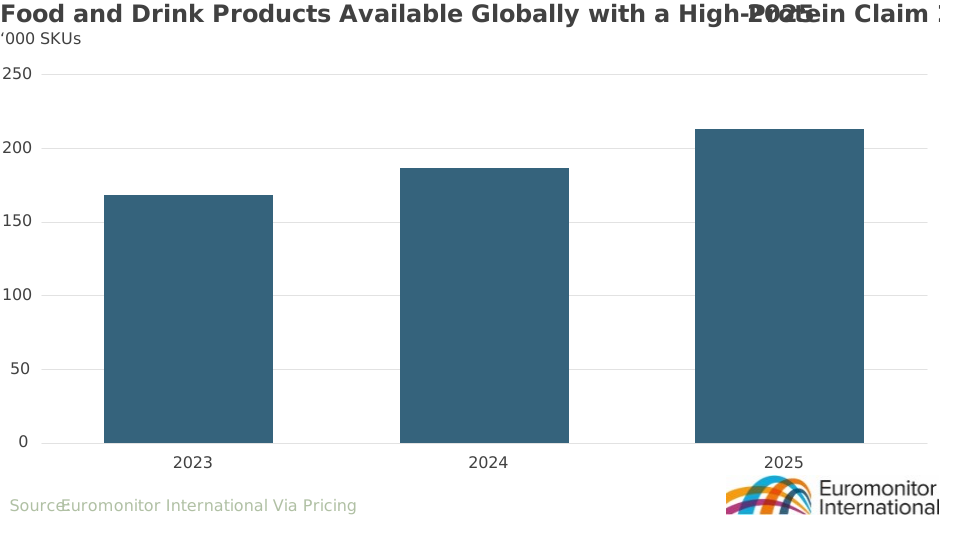
With the rising prices of inputs like whey, a clear oversaturation of the market, cash-strapped consumers putting ever-closer scrutiny on their purchases, and the generally fickle nature of lifestyle trends, it seems likely we are nearing the peak of proteinmaxxing.
After proteinmaxxing, demand will still grow
The proteinmaxxers will move on but protein demand will continue to grow because of four major groups whose protein consumption is not based on the wellness trends of the moment but long-term need. The largest of these is developing markets, specifically the emerging middle classes of places like India who are looking for more protein-rich diets.3% of global protein demand growth in the future will come from developing markets.
93% of global protein demand growth in the future will come from developing markets.
Source: Euromonitor International
In developed markets, more people are taking GLP-1 drugs and engaging in serious resistance training. Both of these groups (which have significant overlap) have lifestyles that require higher protein consumption than they did before. Both groups will continue to expand, in the case of the former because of the falling cost of GLP-1s and in the latter because of larger trends in the fitness space emphasising weightlifting.
Across the world there is also the ageing of the population to consider. As the body ages, the ability to metabolise protein goes down as the need to avoid muscle atrophy goes up, creating a need to increase consumption in this fourth group.
Is there a next protein?
What will today’s proteinmaxxers be looking for in the future? The obvious answer is fibre, which has the ability to speak to a wide range of potential health concerns better than anything else and in which large majorities of consumers in most markets are deficient. Certainly, it will capture some of the momentum that protein will lose, although it has some limitations that it will need to overcome, most notably marketing to men and a clearer conveyance of benefits beyond digestion.
Creatine is another ingredient that, while it will certainly never be as important as protein, is starting to jump in a real way from supplements into food and beverages and is becoming a method of standing out on a grocery shelf where every product already has a protein claim.
However, in many ways, protein is the next protein – a protein segment focused on quality over quantity and built for long-term sources of demand rather than chasing proteinmaxxers through novel high-protein products.
For more on this topic, please read the full report, The Age of Proteinmaxxing and the Future of Protein Demand.