
Leading online marketplace
Operational and cost intelligence for a pan-European logistics carrier programme.
Overview
When your programme spans multiple markets and cost structures shift faster than your data can keep up, operational decisions carry real risk.
We helped a leading global logistics operator close that gap—building an annual intelligence refresh across four workstreams and five European markets that gave their teams a current, consolidated view of carrier cost dynamics and a repeatable model to sustain it year on year.
Business need
Managing a carrier programme at scale means tracking wages, overheads, insurance and profitability across markets moving at different speeds.
The client needed to understand:
- How HGV driver wages and CEO pay were shifting across markets and where they were heading
- Whether insurance premiums were rising and what was driving change by country
- How carrier P&L was performing and how non-programme operators compared
- Whether admin and back-office cost assumptions were still accurate
The original research gave them a strong baseline, but inflation, regional wage differences and wider geopolitical pressure had changed the picture. They needed an update that was rigorous, comparable and fast enough to inform decisions.
Key deliverables
A structured, four-workstream refresh across five countries built for speed, consistency and clear insight into what was changing the data.
Driver Wages
Updated HGV wage structures across five markets using a consistent two-job-board methodology. We refreshed wage tiers, assessed macroeconomic impacts and extended projections to 2027, helping the client anticipating labour cost pressures before they hit.
CEO Salaries
Updated compensation benchmarks for carriers in the 10–30 truck segment, aligned to current revenue trends and business structure changes. This gave the client a practical input for incentive design and negotiation.
HGV Insurance Premium Assessment
Updated motor, cargo and trailer premium estimates across all markets, including one new country and deeper coverage in another. We reviewed around three providers per market and assessed renewal cycles, deductibles, payment terms and loyalty dynamics, giving the client a clearer view of both cost burden and risk.
Admin, Back-Office and P&L
Two linked workstreams built a fuller view of carrier economics. The admin and back-office analysis broke overhead costs into five components—payroll and accounting, dispatcher, transport manager, general admin and recruiting/licences/device—expressed as a share of revenue for like-for-like comparison. The P&L benchmarking assessed 10+ non-programme carriers per country on profitability, operational KPIs, and practices, with anonymised profiles of top performers highlighting transferable efficiencies.
How we worked
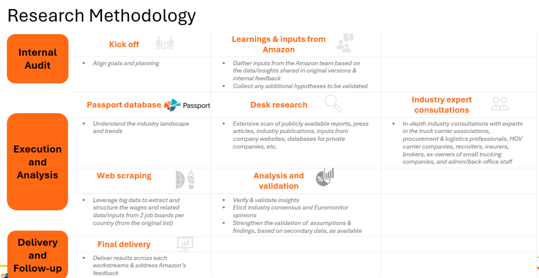
We built on the original studies’ methodology and frameworks, keeping results comparable while focusing analysis on what had changed and why.
Findings were delivered in two formats for different uses:
- A visual Excel workbook with full year-on-year data for trend analysis and modelling.
- Centralised global report with one page per country and workstream, focused on the drivers behind change.
The Value
An annual refresh is not just about keeping data current. It helps teams make better programme decisions in markets that move quickly.
For this client, the refresh delivered several benefits:
- Updated wage projections gave their teams a forward view on labour cost exposure—critical for pricing, contracting and incentive design.
- Deeper insurance analysis revealed dynamics, particularly around provider relationships and loyalty, that had direct implications for how carriers manage risk and cost.
- The admin and back-office granularity enabled more precise modelling of carrier economics and more substantive commercial dialogue with partners.
- Non-programme benchmarking surfaced operational practices—across fleet management, administrative efficiency, and cost structure—that could strengthen the programme itself
This engagement established something the client had not previously had in this form: a scalable, repeatable research model. The same methodology, the same structure, the same output format—refreshed annually, optimised with each cycle.