Payments and LendingWant to understand consumer and commercial payments by instrument or fintech solutions? We analyse the latest payment trends and innovations that are shaping the changing payments landscape.
Early in May, regional and international financial institutions met in San Diego to discuss the impact of AI, regulation, and innovation in financial services and the impact they will have in the US over the coming years. Euromonitor International was in attendance and moderated a panel discussion on embedded lending and its potential to 2030.
AI everywhere and impacting everything
By far the leading topic discussed was how AI can improve financial services. There were numerous discussions on how AI can streamline the lending process, improve security and authentication and customer service. AI has already been fully integrated into various avenues of lending and payments, but the emphasis was on what is next and how AI can automate and accelerate changes already underway.
The future of embedded lending
Euromonitor has covered embedded finance in a series of global briefs that outline how the integration of payments is advancing and how it is changing commerce. The next step in this process is how embedded lending is becoming standard in commerce and becoming a consumer expectation rather than a value-added service. BNPL platforms have increased their reach across geographies and across merchant categories ranging from daily groceries to medical procedures. We have also seen adoption of BNPL options across income segments, suggesting that the lending alternative is not restricted to expanding consumers’ spending potential.
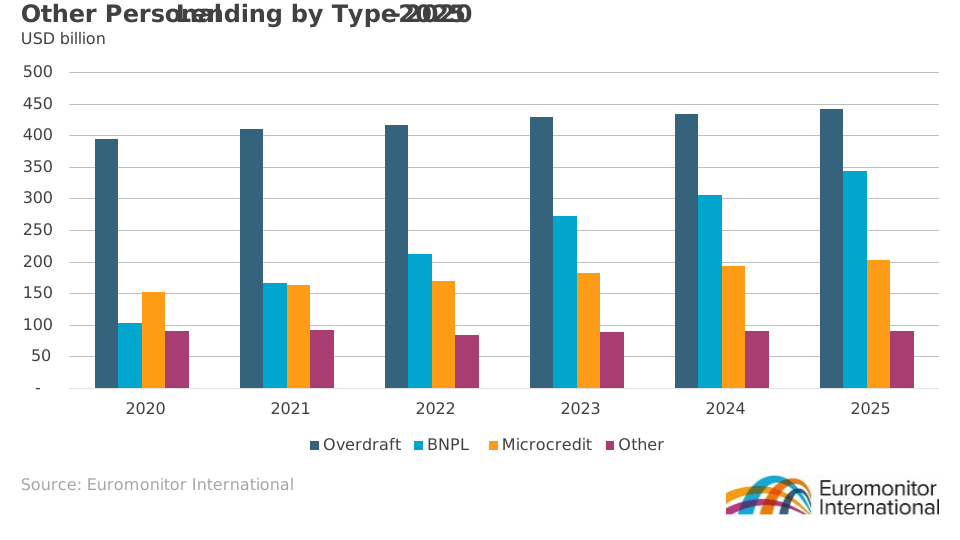
Total BNPL lending across the 47 markets researched by Euromonitor reached USD344 billion in 2025 from only USD103 billion five years earlier.
Source: Euromonitor International
During Euromonitor’s panel, Stacy Bishop, the founder of Selling Fintech, Tiffani Montez of EMARKETER and Bjoern Nordmann of TruStage discussed the future of embedded lending. Stacy Bishop emphasised the disconnect between the consumer’s view of the lending process and that of the financial institution: consumers see it as a problem whereas banks see it as a process, and aligning those views requires meeting the consumers where they are. She emphasised the need to make the process seamless and personalised for the consumer. Tiffani Montez noted that the role of embedded lending is particularly applicable to SMBs by aligning credit with real operational needs. The shift to serving small merchants requires financial institutions to shift their thinking to that of cashflow rather than credit products. Finally, Bjoern Nordmann made the point that the shift in financial services to be more consumer-centric is not just an ideal but an expectation and is an opportunity to build a deeper relationship with consumers. Financial institutions must be responsive to consumer needs quicker and more responsive should an issue arise.
Finovate Spring was a dynamic event that connected key fintech innovators with regional, national and international financial institutions and credit unions. For additional coverage of developments in fintech, see Euromonitor’s latest briefing, Fintech’s Next Phase: Lending, Security and Digital Currencies.
Global mobility is shifting from ownership to access, anchored by commuting demand yet reshaped by technology and affordability. EV intent is strong (49%) but…