
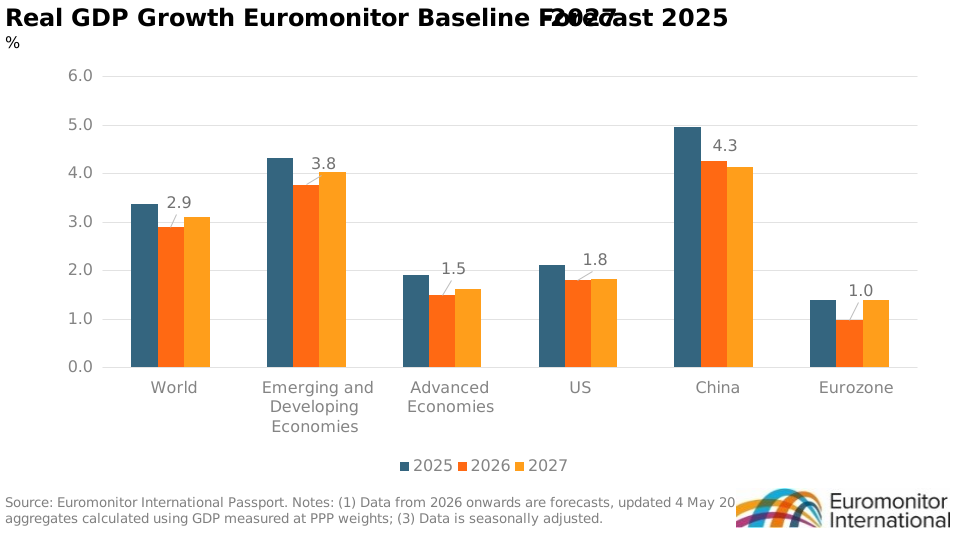
The blockage of the Strait of Hormuz, a consequence of the US/Israel-Iran war, has emerged as the defining economic disruption of 2026. Strait closure drove Brent crude prices up 45% during February-March 2026 and prompted Euromonitor International to revise its global GDP growth forecast for 2026 down to 2.9%, from 3.1% projected in January. The impact extends beyond energy markets: rerouted shipping, airspace restrictions and disrupted exports of petrochemicals and fertilisers have raised freight and input costs globally, reducing margins and exposing the depth of vulnerability in energy importing and trade-dependent economies.
Global inflation is projected to reach 4.6% in 2026, up from 3.5% projected in January 2026, as energy price shocks permeate transport, manufacturing and food sectors.
Source: Euromonitor International
Advanced economies show varied resilience to energy shocks
Among advanced economies, dependence on imported hydrocarbons translates energy shocks directly into inflation, prompting central banks to raise interest rates at a time when higher borrowing costs further weigh on growth.
Emerging and developing markets face energy vulnerabilities and trade complexities
Across emerging and developing markets, the Hormuz disruption amplifies pre-existing structural vulnerabilities, yet outcomes diverge sharply depending on countries’ economic model and energy exposure. China's slowdown reflects the compounding of longer-standing weaknesses, including decelerating real estate, weak household demand and softening global export appetite, even as diversified energy sourcing provides partial insulation. India, conversely, sustains its growth momentum through domestic consumption and infrastructure investment, though imported inflation via fuel and fertiliser costs, combined with agricultural climate-related risks, threatens real purchasing power. Brazil gains marginally from elevated oil prices as a net exporter, but reduced global commodity demand and domestic fiscal constraints limit the broader uplift.
Enhancing resilience amid geopolitical uncertainty
Euromonitor International's baseline projection rests on the assumption that the US/Israel-Iran war remains contained, with Hormuz disruption easing gradually through mid-2026. Yet the trajectory of the war is far from certain, and three alternative scenarios illustrate how materially outcomes could diverge.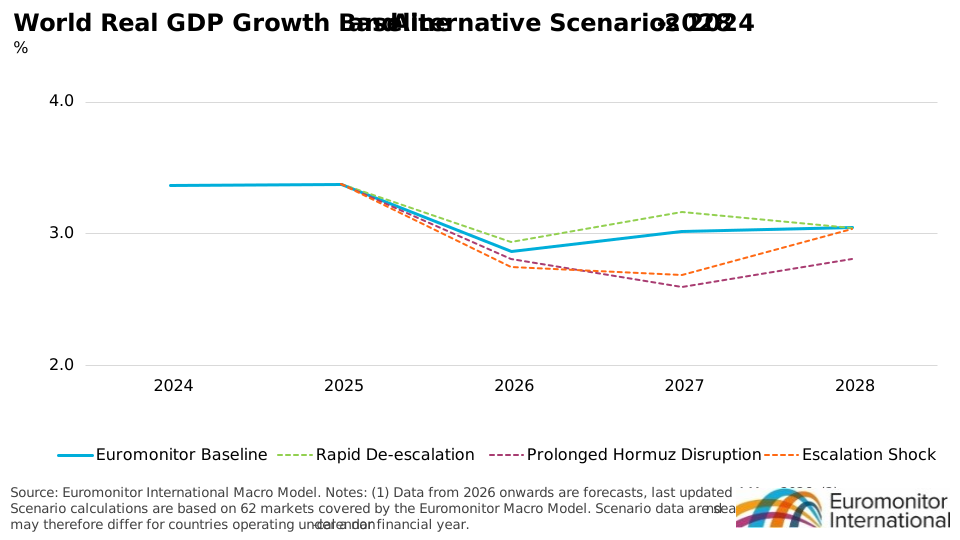
Prolonged Hormuz Disruption extends the blockage to early 2028, creating a slow accumulation of cost pressures, persistent inflation and deepening growth shortfalls over time. Escalation Shock captures an intensity risk – conflict sharply worsens before resolving by mid-2026, triggering an acute spike in energy prices and inflation before a faster normalisation. Rapid De-escalation assumes an early resolution, relieving energy costs and restoring business confidence ahead of expectations.
The predominant trend is a redefinition of economic resilience, with energy security and supply chain robustness becoming fundamental to competitiveness. Organisations that proactively adjust to these conditions will be better positioned to manage cost pressures and sustain growth amid ongoing geopolitical tensions.
Download an extract of updated projections across 10 economies with regional outlooks for the US, UK, Eurozone, China and ASEAN. Further analysis is available in the full report, Global Economic Forecasts: Q2 2026.
Disclaimer: This content was written with the assistance of AI. All information is original to Euromonitor and is derived from our report titled Global Economic Forecasts: Q2 2026. The final article has been thoroughly reviewed by our team to maintain the highest standards of quality and integrity.
