
The signing of the US-Iran Memorandum of Understanding (MoU) on 17 June 2026 marks a critical turning point in what has been the defining economic shock of the year. The Strait of Hormuz blockage, which severed a critical energy corridor, drove oil prices sharply higher, eroded household purchasing power, and compressed corporate margins across energy-intensive industries. The deal signals the start of a shift from disruption to stabilisation, even as conditions on the ground confirm that recovery will unfold gradually rather than swiftly. Energy markets are improving, but the second half of 2026 is still likely to be defined by volatility, implementation risk and uneven exposure across economies and industries.
Strait of Hormuz reopening on track with Euromonitor baseline assumptions
Recent developments are broadly in line with Euromonitor's baseline scenario, which assumed the US/Israel-Iran war would remain contained but unresolved through Q2 2026, with Strait of Hormuz disruption persisting through H1 2026 and conditions beginning to improve from Q3 2026 onwards. Brent crude was forecast to remain above USD90 per barrel through H1 2026 under the baseline — and indeed dropped below that threshold only on 11 June, following news of the impending MoU.
The Strait of Hormuz remains the principal channel through which the war is transmitting its impact on the global economy. Traffic through the strait is recovering gradually but remains significantly below pre-war levels.
The Strait of Hormuz serves as the principal export route for Gulf producers, with GCC countries accounting for 28% of global oil exports and 11% of world natural gas exports in 2025.
Source: Euromonitor International
The majority of GCC oil transited the Strait, so its continued disruption carries significant consequences for global energy supply.
The Strait is likely to remain only partly open through the second half of 2026, as ongoing de-mining operations, a fragile ceasefire, unresolved questions over transit administration, and lingering shipper uncertainty continue to constrain the full restoration of flows — keeping risk premia and cost volatility elevated even as the political situation gradually improves. While the closure has tightened global energy supply and pushed risk premia higher across the region, two factors have partially cushioned the impact: the rerouting of shipping through alternative corridors, and the release of strategic reserves by major consuming nations — measures that have helped prevent a more acute supply shock, even as freight and insurance costs remain elevated.
Further supply relief is possible while escalation risk still unresolved
A full and rapid reopening of the Strait has become more probable following the MoU. Beyond the restoration of pre-war GCC export flows, Iran — which accounted for 2% of global oil exports in 2025 — is positioned to recover lost export capacity as sanctions relief advances. UAE's decision to leave OPEC adds a further potential supply upside, with additional Gulf production capacity available to accelerate the easing of global energy prices should political conditions allow.
A renewed intensification of the war, however, cannot be dismissed. Euromonitor's escalation shock scenario assumes war intensifying sharply in 2026, with oil prices spiking 40% and gas prices 50% above the baseline, pulling global growth 0.2 percentage points below baseline in 2026 and increasing inflation by 0.8 percentage points in 2026, with rapid pass-through across industrial inputs, freight and agriculture.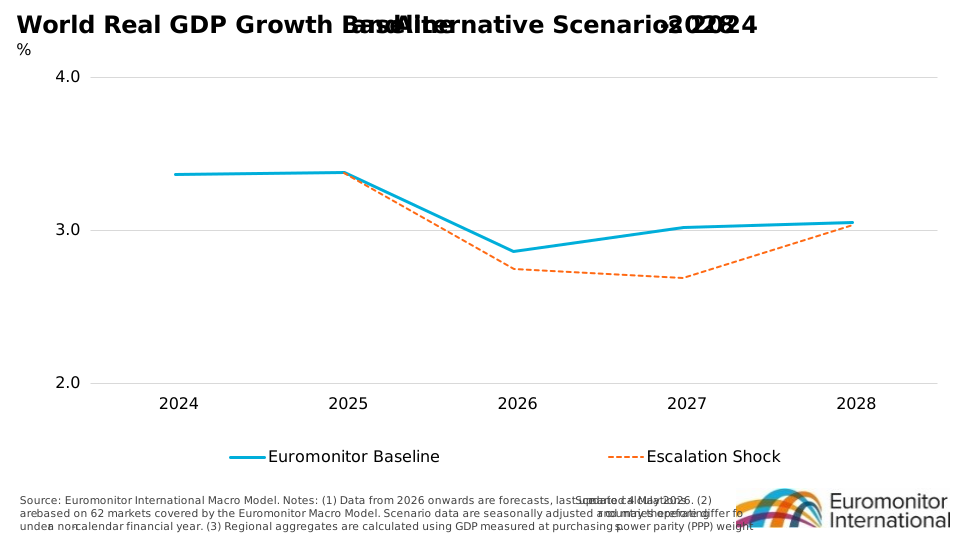
Emerging markets and Asia most exposed to disruption
Sensitivity to a renewed Hormuz disruption varies considerably across the global economy. Emerging and developing economies face the greatest risk of sustained inflation increases: energy-intensive manufacturing, agriculture and transport account for a larger share of output in these markets, weaker currencies amplify import cost pressures, and limited fiscal buffers leave governments with less capacity to absorb the shock. Asia is particularly exposed: India imported 89% of its crude oil in 2025, and ASEAN's high dependence on imported energy means that higher fuel, utility and shipping costs are compressing margins across manufacturing, logistics and consumer goods – reinforcing the region's vulnerability to any prolonged disruption to Gulf supply routes.
Advanced economies, where services account for a considerably larger share of GDP, face comparatively less pressure — but energy-importing countries with significant manufacturing bases, such as Japan and Germany, remain meaningfully exposed should the situation deteriorate.
Download the 2026 global economic update and mid-year outlook or explore more in Euromonitor Global Economic Forecasts report.
