
Whilst closer Canada-EU alignment is strategically significant and means closer political, security and defence cooperation, its commercial impact will be narrower than the news headlines suggest. Commercially, it builds on the Comprehensive Economic and Trade Agreement (CETA), which had already abolished most tariff lines between EU and Canada by 2024. The main export obstacle is thus no longer tariffs but the standards and certification differences that continue to create friction between Canada and the EU, as well as with Canada's deep integration with US supply chains, and the distance and transport costs of redirecting trade towards Europe.
US trade uncertainty pushes Canadian exporters towards Europe
Canada has made export diversification a policy priority as tariff conflict and US trade uncertainty expose the risks of overdependence on one market. Although the US remains the dominant destination, its share is gradually easing as the EU and UK gain importance for Canadian exporters, even if neither can yet match the scale of the US market. Export growth to the UK was stronger than to the EU, but was largely driven by gold, while growth to the EU was more diversified.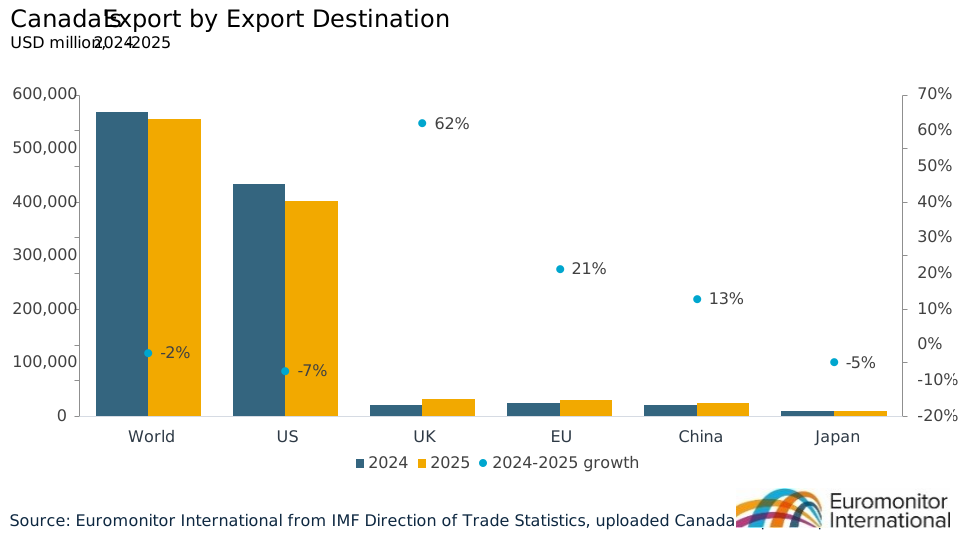
The opportunity in the EU for Canadian exporters is selective, not economy-wide. Multiple food products, such as pork, have tariff advantage, but require additional certification for rerouting. Canadian canola, referred to as rapeseed in Europe, is another likely opening, especially for biofuel and industrial use, where Europe needs feedstock and fuel but requires sustainability certification, chain-of-custody and approved varieties.
Canada’s tariffs create openings for EU suppliers
Canada's September 2026 counter-tariffs create selective openings for EU manufacturers where US-origin goods have become more expensive or less attractive to stock. The clearest opportunities are in categories where European products already enter Canada at low or zero duty under CETA, and where US alternatives can be replaced without major product redesign or consumer education.
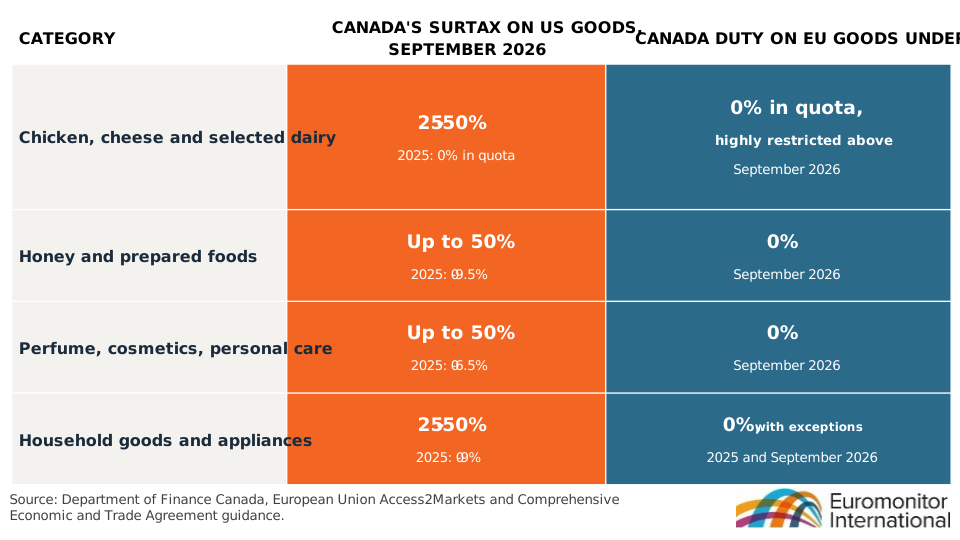
The tariff openings span several areas: EU cheese and speciality foods, where US dairy and prepared foods face higher surtaxes; beauty and personal care, where US-origin products face up to 50%; and selected household goods, where European ranges can replace tariff-hit US lines without reformulation. Retailer moves reinforce the shift – provincial liquor boards have removed American spirits from listings. Grocers and beauty retailers can reduce US SKUs, reallocate shelf facings to domestic or European brands, and use private label or alternative suppliers to protect margins. Consumer sentiment makes origin more visible at the point of purchase, but the opportunity is strongest where the retailer also has a price, margin or supply reason to switch.
For businesses, the Canada-Europe opportunity is selective, not automatic. Companies that can prove compliance, manage logistics and show a clear margin benefit will be best placed to reroute Canadian exports to Europe or replace US-origin goods on Canadian shelves.
Strategic partnership beyond consumer goods
Closer EU-Canada ties open a broader frontier than tariff relief: industrial complementarity. Canada supplies the critical minerals, uranium and clean energy that Europe needs for batteries, clean-tech and advanced manufacturing as it de-risks from China and Russia. The EU brings the precision machinery, engineering depth and mature aerospace and defence industrial bases that Canada needs to scale domestic capacity. These complementary strengths could build more resilient, value-retaining supply chains – with more high-value processing on both sides of the Atlantic.
Read more in our latest report, Global Economic Forecasts: Q3 2026.