
In a world where market volatility, budget pressure and geopolitical shocks have become everyday reality consumers have to navigate, FMCG boardrooms are asking the same question: do consumers still care about sustainability? The data says yes.
Climate concern has held steady at around 60% globally for two years running, and 45% of consumers still try to make a difference through their actions. Behaviour is following intent. Global sustainability sales reached USD886.2 billion in 2025, growing at a 6.7% CAGR between 2020 and 2025, and outpacing their non-sustainable counterparts by 1.3 percentage points. The shift is not whether consumers care, but what caring looks like.
The lone eco-hero is exhausted
Sustainability marketing has always leaned on the premise that individual choices can make a difference. Your choices, your impact, your share of the planet to save. The model held while consumers had the bandwidth to carry it; but that bandwidth is under strain. Consumers still care, but they are increasingly stretched by financial pressures, geopolitical uncertainty and the demands of everyday life. Euromonitor’s Voice of the Consumer: Health and Nutrition Survey, fielded January to February 2026, shows that 57% of global consumers experience moderate to extreme stress daily. Sustainability is not less important; it has become harder for consumers to prioritise alongside everything else they are navigating. Consumers no longer want sustainability to feel like another responsibility they must take on alone.
That said, sustainability has become mainstream. What once differentiated products for environmentally conscious consumers is now expected by the broader market. Recyclable packaging (57%), locally sourced (57%), natural (55%), organic (53%) and environmentally friendly (52%), are the most trusted product claims globally and baseline expectations today. Price premiums have not disappeared; they have simply become harder to earn. They now belong to claims that are substantiated, specific and tied to something the shopper can see and measure. L'Oréal’s June 2025 #JoinTheRefillMovement campaign illustrates this shift. Bringing together Lancôme, YSL, Armani, Kiehl's, Prada and La Roche-Posay, the campaign translated refillable sustainability into a visible action with a measurable result. Choosing a 100ml La Vie Est Belle refill instead of two 50ml bottles costs 46% less per millilitre, while also reducing glass use by 73%, plastic by 66%, and cardboard by 61%. Rather than asking consumers to make an abstract sacrifice for the planet, it provides a simple, repeatable action with an outcome they can easily understand.
From saving the planet to tangible human impact
Consumers are no longer evaluating sustainability through environmental impact alone. Increasingly, they want sustainability to have a face, a beneficiary: who made it, how the workers were treated, whether farmers received a fair income, was the animal raised responsibly. Tim Hortons' Tims for Good platform, launched in August 2025, reflects this shift. The programme assesses all coffee purchases against social and economic indicators as well as environmental, and targets direct support for 18,000 farmers across sourcing regions. For consumers, the sustainability story is not just about responsible sourcing; it is about real communities and livelihoods.
This shift is already reshaping category growth. 48% of global consumers trust sustainably sourced claims, and products carrying social and ethical claims have consistently outperformed overall category growth since 2020.
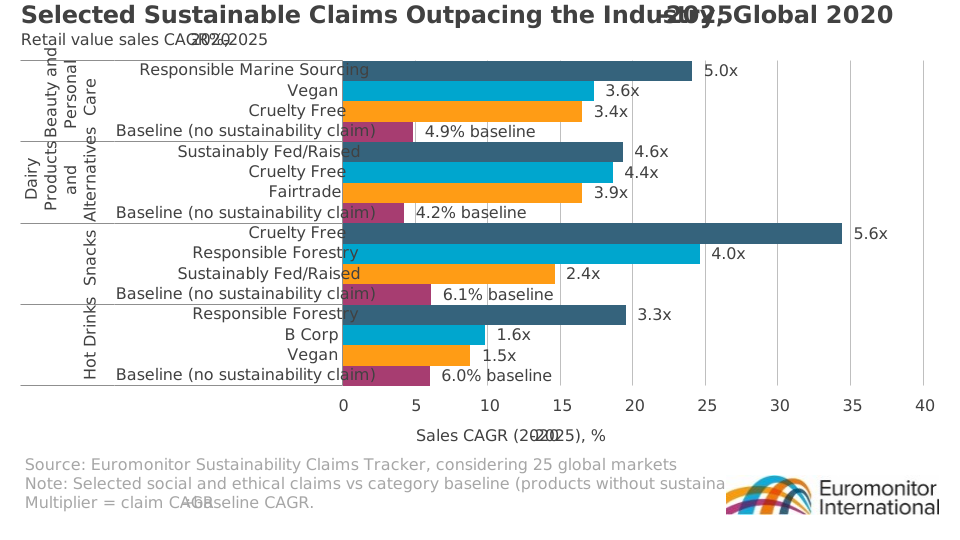
This works because these claims translate complex environmental challenges into tangible human benefits. Fair wages in cocoa, no child labour in coffee, grass-fed dairy and locally-sourced ingredients give shoppers a name, a face, a place to picture. Tony's Chocolonely shows how powerful that translation can be. Its unequally divided chocolate bar turns cocoa inequality into something shoppers can literally hold in their hands, while its fully traceable supply chain provides proof behind the promise. As the brand expands internationally, supported by its first-ever global TV campaign, "There's Fight in Every Bite", its message is simple: joining the fight against exploitation is as easy as picking up a bar. The appeal lies in making impact feel immediate and personal. "I bought this and someone is better off" is a far more tangible proposition than "the planet will be fractionally less warm in 2050". Tangible human good earns attention and justifies a premium in a way carbon accounting has struggled to.
This is not a niche curiosity. It is a quiet rewrite of what "good" means in FMCG, and the brands still selling sustainability as environmental virtue alone are under-pricing what today's shopper is willing to pay for.
See which sustainable claims are driving growth in your category with Euromonitor Sustainability data.