
Heat pumps are moving from niche heating technology to a central part of residential electrification. As governments push to decarbonise homes, the category is gaining momentum, but adoption is not progressing evenly. Policy clarity, regional heating infrastructure, upfront costs and installer capacity are now shaping which markets grow fastest and which risk slowing down.
Government policy is setting the pace
Heat pump demand remains highly dependent on government signals. Electrification mandates and subsidy schemes can accelerate consumer adoption, while unclear or changing policies can quickly weaken confidence. This makes policy predictability more important than the size of individual incentives. Markets with long-term regulatory support give manufacturers and retailers the confidence to invest, plan capacity and communicate benefits clearly to consumers.
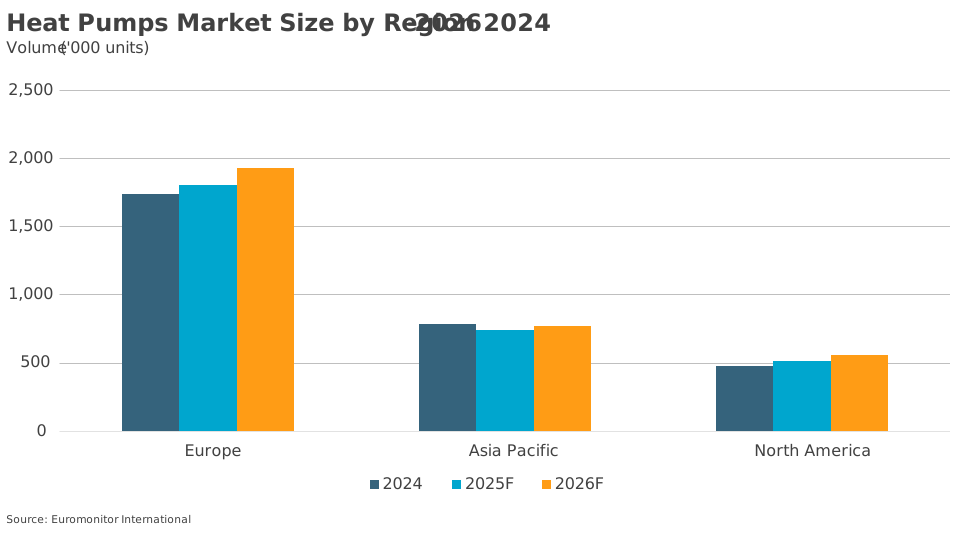
Europe shows how policy can mobilise the market. The REPowerEU initiative supports heat pump adoption through long-term installation targets, while Viessmann’s EUR1 billion investment in production capacity illustrates how clearer policy direction can encourage industry expansion. However, Germany’s 48% sales decline in 2024 highlights the opposite effect: when subsidy rules are confusing, consumers delay decisions and demand weakens.
Germany’s heat pump sales fell by 48% in 2024 amid subsidy confusion, showing how quickly policy uncertainty can affect consumer demand.
Source: Euromonitor International
Regional infrastructure shapes technology choices
Heat pump adoption is also highly regional. North America’s ducted forced-air systems favour air-to-air heat pumps, while Europe’s hydronic heating legacy supports stronger demand for air-to-water models. Asia Pacific leans towards air-to-air systems, helped by established air conditioning markets and China’s production scale. These differences mean manufacturers cannot rely on a single global product strategy.
Product innovation is beginning to reduce some regional barriers. Cold-climate technologies are expanding heat pump viability in northern regions where performance concerns have historically limited adoption. Terravis Energy’s AetherLux, for example, is positioned as an air-to-air solution designed to operate efficiently at temperatures as low as -57°F without energy-intensive defrost cycles. In Europe, Daikin’s Altherma 3H HT addresses local housing needs by producing hot water up to 70°C for homes using existing radiator systems.
Even where policy and technology are favourable, high upfront costs continue to slow adoption. Heat pump units can range from EUR1,000 to EUR10,000, with installation costs often 2-3 times higher than traditional gas boilers. This makes financing, transparent pricing and total cost-of-ownership messaging essential to converting interest into purchases.
Subsidy volatility adds another layer of risk. In the US, demand surged ahead of the 2025 expiry of Inflation Reduction Act incentives, but the subsequent rollback of federal tax credits has created uncertainty for manufacturers and retailers. Hybrid systems from companies including Bosch and Daikin are emerging as a more accessible stepping stone, allowing households to combine heat pumps with existing gas or oil systems and reduce the need for immediate full retrofits.
Winning strategies need to be local and practical
For businesses, success will depend on responding to policy cycles, localising product portfolios and reducing financial friction. Retailers can help consumers navigate subsidies through real-time eligibility guidance, while manufacturers can align product development with regional housing stock, such as high-temperature air-to-water systems in Europe or air-to-air systems for ducted homes in North America.
The longer-term opportunity goes beyond heat pumps as standalone appliances. As residential electrification matures, competition will shift towards connected home energy ecosystems that integrate heating with solar panels, batteries, smart tariffs and home energy management. Companies that position heat pumps as future-proof energy assets, rather than simple heating replacements, will be better placed to capture long-term value.
Learn more in Euromonitor International’s briefing, Heat Pumps: The Sustainable Heating and Cooling Appliance, to explore how policy, infrastructure and affordability are reshaping the next phase of residential electrification.