

Understanding how key ingredients evolve in industries requires moving beyond marketing narratives and into measurable adoption.
Tracking ingredient usage across stock keeping units (SKUs), categories and countries shows where ingredients are gaining traction and how their role in formulations is changing. It reveals whether an ingredient is in an early commercial phase, scaling or evolving to mainstream. In our Ingredients Spotlight series, we’ll take a look at bakuchiol and how and where the ingredient has gained visibility for combining anti-ageing benefits with improved tolerability.
From rapid growth to more structured global expansion
Bakuchiol has experienced a sharp increase in usage since 2021, signalling a clear shift beyond niche adoption. Using our ingredients database, the number of beauty and personal care SKUs containing bakuchiol increased by 301% globally between 2021 and 2025.
While early growth was driven by novelty and “gentle alternative” positioning, recent data suggests a transition towards a more stabilised growth phase. This pattern points to increasing maturity, where expansion is no longer defined by rapid uptake but by broader integration into existing product portfolios.
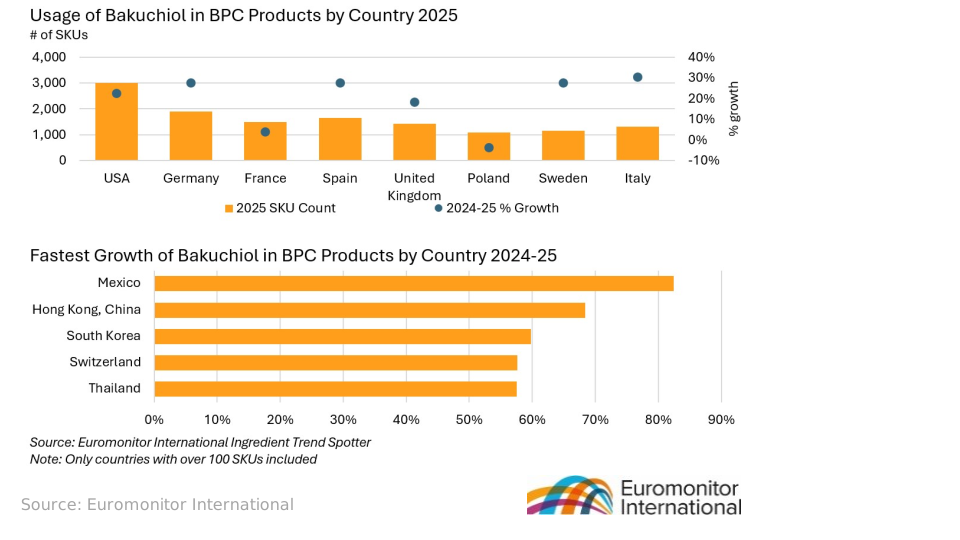
Geographically, bakuchiol’s footprint is widening. The US continues to anchor global usage, but growth is increasingly distributed across Western Europe, with markets such as Italy, Germany and Spain showing strong gains. At the same time, faster expansion is emerging in smaller, less saturated markets, including Mexico, South Korea and Thailand. This divergence suggests that while larger markets continue to provide scale, significant headroom remains in regions where adoption is accelerating from a lower base.
Across these markets, adoption remains heavily concentrated in skin care SKUs, particularly within facial care formats such as serums and moisturisers. This reflects bakuchiol’s core role in anti-ageing and skin-conditioning routines, where demand is shifting towards preventative, daily-use solutions rather than intensive corrective treatments. While penetration into adjacent categories remains limited, this concentration underlines its strong alignment with skin care-led innovation and points to future expansion opportunities beyond core formats.
Avène scales bakuchiol through clinically led, multi-ingredient systems
Tracking SKUs with bakuchiol at the brand level shows that bakuchiol adoption remains fragmented, with no single player dominating. Instead, its use spans mass, dermocosmetic and premium segments, reinforcing its versatility as an ingredient. Within this landscape, Avène emerged as the largest identified brand by SKU count in 2025, accounting for 4.4% of global beauty and personal care SKUs containing bakuchiol.
Rather than positioning bakuchiol as a hero ingredient, Avène incorporates it within multi-ingredient formulations that prioritise efficacy and tolerability. This approach reflects a broader shift away from single-ingredient storytelling towards formulation-led innovation. In products such as Cleanance Comedomed Intensive Serum, bakuchiol functions as a supporting active within a wider acne treatment system, contributing to skin renewal while maintaining a barrier-friendly profile.
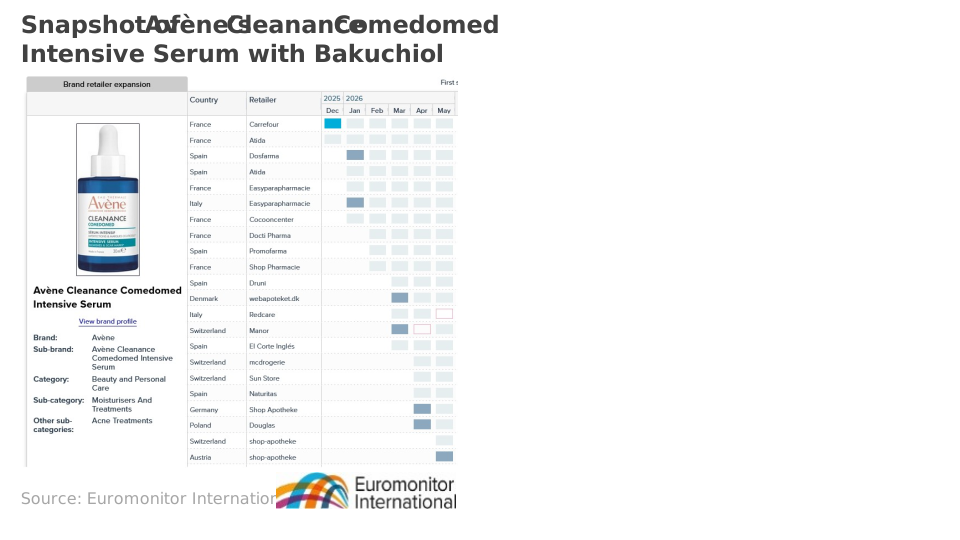
As seen in our Passport Innovation database, since launch, Cleanance Comedomed Intensive Serum has rapidly expanded across both retailers and geographies, with distribution spanning multiple European markets and a diverse mix of pharmacy, e-commerce and specialist beauty channels. This broad and accelerating roll-out signals strong commercial traction, demonstrating Avène’s ability to scale clinically positioned, multi-ingredient formulations across markets rather than limiting innovation to a single region or channel.
This approach highlights an important shift in how bakuchiol competes within the market. As more ingredients occupy the “gentle efficacy” space, differentiation is less about the ingredient itself and more about how it is formulated, combined and delivered within routines. In this context, bakuchiol is evolving from a standalone selling point into a supporting active within multi-product treatment systems.
Avène’s strategy illustrates how this shift translates into commercial outcomes. By embedding bakuchiol within scalable, clinically grounded formulations and expanding distribution rapidly across retailers and markets, the brand demonstrates how ingredient adoption can help drive sustained, cross-market growth. Crucially, this underscores the value of tracking ingredients at the SKU level, where it becomes possible to link formulation choices to real-world distribution, positioning and performance across categories and geographies.
Find the full briefing in our report store or Passport platform for deeper analysis on bakuchiol, and explore our ingredient intelligence page to see how SKU-level tracking helps uncover emerging ingredient trends, competitive dynamics and innovation opportunities.