Retail and E-CommerceOur experts provide analysis on the retail industry, featuring insights from a local to global level on where and how consumers will shop across both traditional and emerging retail channels.
One in two consumers globally are using ChatGPT to search for products in 2026. Nearly four in five say AI has introduced them to a brand they hadn't considered before. And yet, we ask a shopper in Shanghai and a shopper in Seattle how they use generative AI to buy things, and there are two different stories that barely resemble each other.
Generative AI (GenAI) platforms are often framed as a universal shift in product search, but brands can make a strategic lapse assuming this transformation is unfolding uniformly across the world.
The myth of one global path for GenAI commerce
Euromonitor International’s Voice of the Consumer: Digital Survey, spanning over 20,000 consumers globally, suggests that this is not one global shift in shopping behaviour, but two structurally different paths emerging in parallel. Increasingly, brands need to understand both.
The contrast is not simply on account of AI tools popular across markets, but reflects deeper differences in platform ecosystems, consumer habits and the role AI is beginning to play in the path to purchase.
In China, the GenAI landscape is being shaped by domestic leaders such as Qwen and DeepSeek, while Western platforms have more limited reach. Despite native AI platforms, stringent regulatory landscape and later roll-out of consumer-facing GenAI platforms, adoption patterns in China are stronger.
Only around 3% of consumers report not using any generative AI platform for shopping in the past month, compared with roughly 16% in both the US and UK.
Source: Euromonitor Voice of the Consumer: Digital Shopper Survey, fielded March 2026 (n=15,555 across 21 markets)
The Western pattern looks different. The UK is more clearly ChatGPT-led, with 48% using ChatGPT. The US is more distributed across ChatGPT, Gemini and Meta AI, but across both markets consumers are using GenAI primarily as an external layer for research and guidance rather than as an embedded transactional environment.
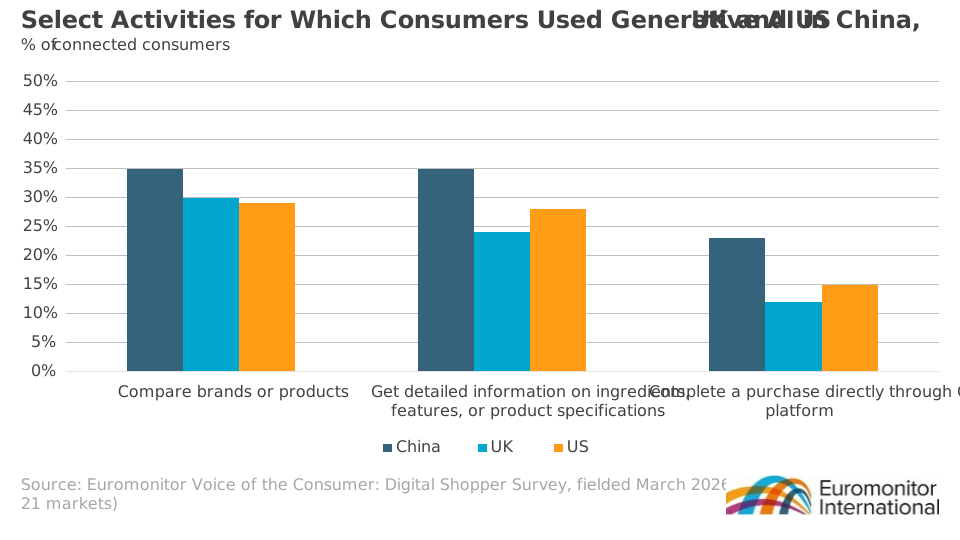
This difference is evident in how consumers use AI. China is ahead on agentic and transactional use cases: 23% say they purchase directly through AI, versus 12% in the UK and 15% in the US.
What Alibaba and Amazon are telling us about where this goes
These differences are already defining the platform strategies. Alibaba recently announced plans to embed its Qwen AI platform directly into Taobao and Tmall, giving it access to more than four billion product listings, as well as logistics, after-sales support, and personalised recommendations based on purchase history. The aim is to move from keyword search to conversational commerce: shoppers describe what they want, and the AI manages discovery, comparison, and purchase within one seamless in-platform journey.
By contrast, Amazon has taken a more cautious approach. Although it introduced its Rufus AI assistant, it remains cautious of a fully autonomous system, testing a hybrid model. Rufus reportedly served more than 250 million customers in 2025 before being retired in May 2026 and replaced by Alexa for Shopping. In both cases, Amazon is using AI to enhance search rather than replace it, layering conversational guidance on top of its existing model.
ChatGPT also adds an important external layer to Amazon’s discovery ecosystem. In the US, more than 61% of AI referrals from ChatGPT went to Amazon in 2025.
Several US retailers, including Target, Instacart, and Sephora, have enabled direct integrations within ChatGPT. However, the US model remains fragmented, relying on coordination across multiple apps while giving retailers less control over the underlying LLM infrastructure. In this set-up, chat-based retail integrations extend marketplace strategies rather than replace them, supporting a wider range of shopping behaviours across platforms.
One technology, two futures
Clearly, consumer trust sits differently in each market, pointing to diverse futures:
The consumer who opens Qwen in Shanghai to find a birthday gift, chats through options, compares prices across Tmall's catalogue, and completes the purchase before their coffee is finished; and the consumer in Seattle who asks ChatGPT for laptop recommendations, spends 20 minutes reading the summary, and then navigates to Amazon or Best Buy to actually buy.
Thus, China is moving towards a world where the AI and the commerce are the same thing, while the West is using AI-shaped commerce but not yet to replace existing structures.
While both trajectories are real and accelerating the adoption of GenAI in commerce, these are fundamentally different commercial environments, having different implications for the brands trying to reach them.
This briefing examines the global delivery platform landscape as the sector shifts from pandemic era expansion towards consolidation, profitability and…
Easing inflation, strong labour markets, consumer fatigue with frugality, the strength of the Asia Pacific consumer base, and the continuing ascendance of…
The Strait of Hormuz blockage is the defining economic shock of 2026, severing a critical energy corridor and driving oil prices sharply higher. Global growth…