
The Q3 2026 outlook is shaped by two reinforcing shocks: the Strait of Hormuz blockage and a more durable US tariff framework. Rerouting, higher Atlantic Basin supply, coordinated releases of strategic oil reserves, and softer oil demand have contained the energy shock, while new 10-12.5% tariffs on imports from around 60 economies have left US market access more costly and uncertain. Euromonitor International now projects global real GDP growth at 3.0% in 2026, with inflation at 4.9%, keeping central banks cautious and delaying a return to easier financial conditions.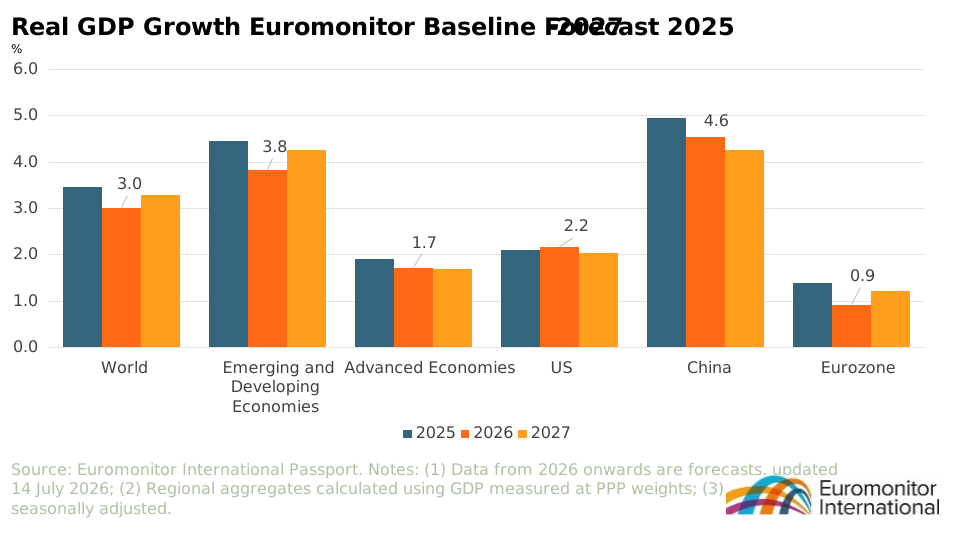
Advanced economies face uneven pressure from imported energy and tariff uncertainty
Advanced economies remain under pressure from imported energy costs, tariff uncertainty and sticky inflation. The US is more resilient thanks to domestic demand, AI-related investment and greater energy self-sufficiency. The Eurozone and UK are more exposed, as high oil and gas import dependence continues to squeeze household purchasing power, manufacturing margins and policy flexibility.
Emerging and developing markets benefit from domestic demand and selective policy buffers
Emerging and developing markets show greater divergence. China has been revised upward on stronger exports, semiconductor activity and technology investment, but weak property and cautious spending persist. India remains the fastest-growing major economy, supported by consumption and public infrastructure investment, though energy import costs and food risks weigh on lower-income households. ASEAN benefits from AI-related manufacturing and China-plus-one investment, Brazil from commodities and labour market strength, while Mexico remains constrained by US tariff uncertainty and the USMCA review cycle.
Scenario planning becomes essential as Baseline assumptions remain fragile
Euromonitor International’s Q3 2026 scenario framework has been refreshed to reflect a more complex risk environment, where energy disruption linked to the US/Israel-Iran war and renewed Trump tariff uncertainty now interact. The Macro Model includes several newly introduced scenarios related to commodity prices: Lasting Trade Disorder, where a prolonged Hormuz disruption keeps freight, insurance and energy costs elevated; Severe Escalation, where renewed fighting creates a sharper but shorter energy shock; Commodity Price Drop, where a permanent peace framework lowers oil, gas, coal, food and transport costs. Trade-policy scenarios, Trade War Escalation and Trump Tariff Easing, test the downside and upside paths for US tariff policy. Together, these scenarios help businesses assess how geopolitical and trade shocks could reshape real GDP growth and inflation.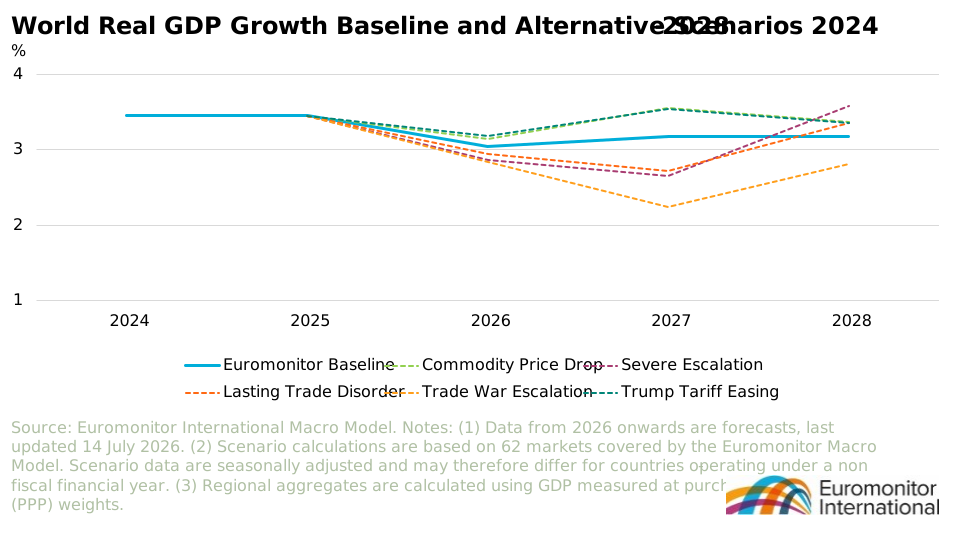
Energy and tariff shocks test global growth in 2027
In 2027, the two most material downside risks to real GDP growth are Trade War Escalation, Severe Escalation and Lasting Trade Disorder. Under Lasting Trade Disorder, global real GDP growth would be around 0.5 percentage points below the Baseline, as prolonged Hormuz disruption keeps energy, freight and insurance costs elevated, weighing most heavily on energy-importing economies such as the Eurozone, Japan, the UK, India and parts of ASEAN.
Under Trade War Escalation, global growth would be around 0.9 percentage points below the Baseline in 2027, with higher US tariffs, retaliation and policy uncertainty weakening trade, investment and supply chains. The impact would be greatest for economies highly exposed to the US market or export-led manufacturing, including China, Mexico, Canada, Vietnam, Japan, South Korea and parts of the Eurozone.
For businesses, the key message is that cost volatility is becoming structural rather than temporary. Scenario-based assumptions on energy, tariffs, sourcing and logistics need to be built into pricing, contracts and inventory planning. Companies that reassess exposure by market and supplier origin will be better positioned to protect margins and identify selective upside if conditions improve.
Further analysis is available in the full report, Global Economic Forecasts: Q3 2026.