
During 25-27 March, US-based retail events organiser Shoptalk held its annual Shoptalk Spring conference in Las Vegas. Retail luminaries had a chance to network while attending a series of keynote sessions, panel discussions, and interactive experiences covering many topics – from generative AI and retail media to social commerce and generational consumer dynamics. Euromonitor International attended, and we are delighted to report on some of the highlights.
Tariffs top of retailers’ minds
With the Trump administration pursuing a policy of “economic nationalism”, retailers around the world are increasingly leery of the potential disruption new trade barriers could inflict upon their businesses. As a result, a reoccurring question during Shoptalk Spring – both on stage and in private conversations – was how retailers and brands planned to navigate the potential imposition of new tariffs. On Day One of Shoptalk Spring, in an interview session titled “Re-Imagining Gap for a New Golden Age”, Richard Dickson – president and CEO of US-based apparel retailer Gap Inc – addressed this topic. Asked about the possibility of new tariffs, Dickson responded that Gap is well placed to navigate the potential threat thanks to the company’s strategy of sourcing less than 10% of its goods sold in the US from China, and less than 1% of goods sold in the US from Canada and Mexico combined. Many conference attendees were surely envious of Gap’s supply chain.
Even in a digital era, a physical retail presence is critical to brands’ success
Two of the highlights of Day One involved Euromonitor’s Michelle Evans, Global Lead of Retail Insights. In a session titled “Anticipating Customer Needs to Deliver Convenience, Speed, and Delight”, Michelle interviewed Sandy Gilsenan, Chief Retail and Customer Experience Officer for US-based optical goods retailer, Warby Parker. While Warby Parker started as a pure direct-to-consumer (DTC) brand, Gilsenan recounted the company’s integration of brick-and-mortar stores into its overall retail strategy. Gilsenan also highlighted Warby Parker’s new partnership with US hypermarkets giant Target, announced in February, which will see the launch of Warby Parker “shop-in-shops” – staffed by Warby Parker employees – in select Target stores in the second half of 2025. Under the partnership, consumers will also be able to discover Warby Parker products on Target’s website.
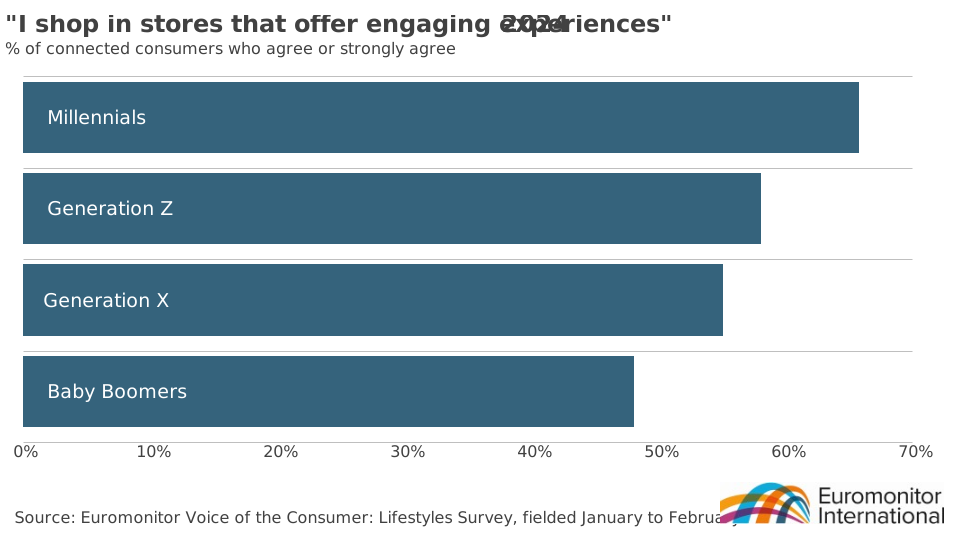
Warby Parker’s journey from pure DTC player to omnichannel retailer is emblematic of the shift in the overall DTC landscape over the last decade, as DTC brands find there is a natural limit to what they can accomplish without some sort of brick-and-mortar presence.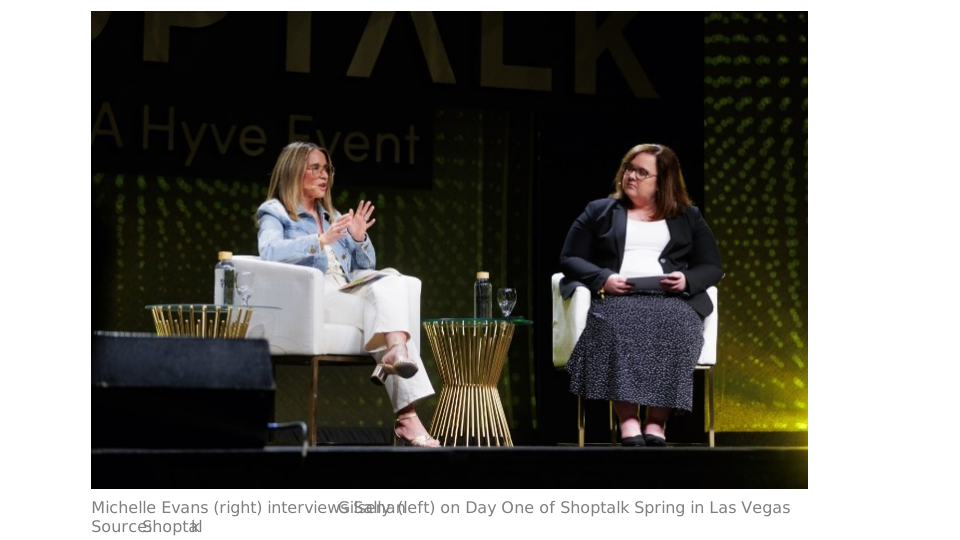
Quorso promises to simplify the flow of data for store managers
On Day Two of Shoptalk Spring, in a session fittingly titled “Technologies Unlocking Business Efficiencies”, four presenters discussed the ways their companies’ technology platforms could help retailers increase their efficiency. One presenter was Julian Mills, co-founder and CEO of Anglo-American tech firm, Quorso. With the amount of data they are bombarded with growing exponentially, store managers increasingly feel swamped. Quorso aims to handle the flow of data more efficiently, by moving data from previously disconnected systems into a single, unified platform. Mills contends that this can help store managers save 50% on their technology costs and provide additional time savings of 10-15% per week. Quorso has recently received strong votes of confidence from important retailers, with Latin American hypermarkets behemoth Walmart México y Centroamérica partnering with the platform provider in October 2024, and US-based forecourt retailer EG America doing the same in February 2025. With Quorso promising to simplify store management and boost productivity in a major way, this tech firm is one to watch.
Download our white paper, Retail Reinvention: A Framework for Future Growth, to help you navigate the rapidly shifting retail landscape in order to protect your bottom line.