
Luxury brands have long refined the purchase moment: the lighting, the associate, the packaging, an unhurried pace – each element converting interest into desire, and desire into margin. AI-mediated commerce is changing this, as AI systems experience none of the elements luxury historically relied on.
The discovery phase of the shopping journey is seeing the strongest impact. Analysis of 36,917 skin care brands shows the trade-off’s cost. Helena Rubinstein, 15th among skin care brands in global e-commerce, ranks 1,531st for AI referrals. For every consumer reaching Helena Rubinstein through AI referral, 300 reach Neutrogena.
Mystique does not survive translation
Luxury and premium skin care has long created value through emotional storytelling, prestige, exclusivity and sensory experience – targeting a human who can feel and interpret those cues. Names like “Miracle Broth” and “PITERA™” are powerful brand assets, carrying decades of accumulated meaning, but when an AI system recommends a product for a specific concern, their proprietary mythology provides little functional information. While not a failure of luxury marketing, this is a predictable consequence of brand architecture designed to preserve mystique. Thus, several leading luxury and premium brands performing strongly in global e-commerce either rank below 100th in AI referrals or register no measurable AI presence. Euromonitor analysis identifies this group as Luxury Revenue Orphans.
Six of the 10 largest luxury and premium skin care brands by e-commerce rank sit outside the top 300 for AI referrals.
Source: Euromonitor International
Estée Lauder and Lancôme emerge as exceptions. Ranked second and sixth, respectively, in e-commerce and among the top 50 for AI referrals, the visibility gap is materially smaller.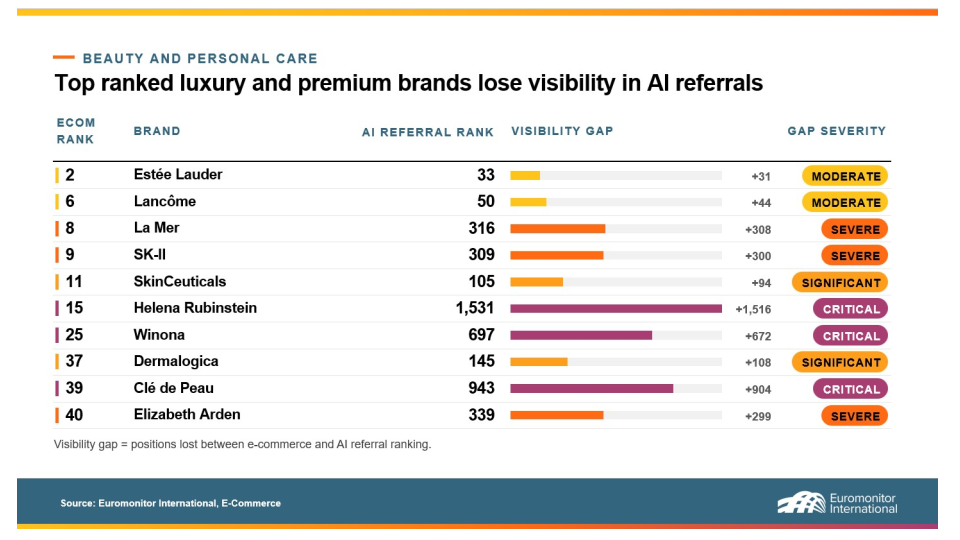
Another caveat is geography. Perhaps Asian prestige brands sit outside the English-language ecosystems from which major AI platforms draw much of their information. SK-II ranks ninth in e-commerce but 309th in AI referrals. Its global e-commerce sales are three times larger than those of COSRX, which ranks 10th in AI referrals. Both are established brands with markedly different communication architectures. For COSRX, the ingredient, concentration and product function are embedded directly in the name. SK-II primarily communicates through the proprietary name, PITERA™.
Distribution reinforces the distinction. COSRX generates 91% of its e-commerce sales internationally. SK-II, by comparison, derives 92% from China, reducing presence within the English-language digital discourse that many global models index heavily.
Brands no longer own the evidence
Another complication for luxury houses accustomed to controlling narratives is that AI systems do not rely on brand-owned communication. For CeraVe and La Roche-Posay, brand websites account for only 14-19% of the sources ChatGPT cites. More than 80% of cited evidence comes from outside the brands’ direct control. For luxury, this represents an inversion of its principles – controlled communication being central to maintain desirability. In AI-mediated discovery, excessive control limits discoverability.
Why the window is closing
Globally, AI-driven referrals grew by 302% in 2025, compared with 40% across all other referral sources combined. In the first half of 2026, the gap narrowed – AI-driven referrals grew by 128% versus a 0.8% gain for other sources. Yet only 8% of the 36,917 skin care brands selling online globally register measurable AI referral activity, creating an unusually concentrated discovery environment.
The longer-term risk is greater still. As AI agents progress from recommending products to executing transactions, many of the environments luxury has traditionally used to convert desire – the boutique, the consultation – risk becoming fulfilment endpoints rather than decision environments. With the potential to become a revenue gap, unlike traditional awareness challenges, increasing media spend cannot solve the problem.
What luxury should do now
The urgency is reinforced by a changing luxury shopper. Gen Z is increasingly important to luxury consumption and uses generative AI for skin care purchases more than both millennials and the average luxury beauty shopper.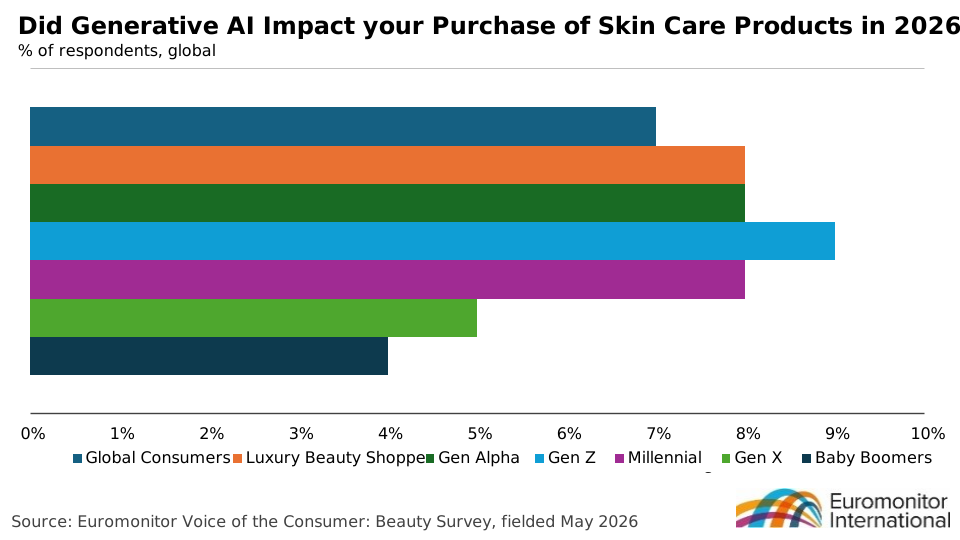
The first step is measurement, as most premium brands cannot currently state the size of the gap between their AI visibility and e-commerce position. Without that baseline, it is difficult to determine whether a brand's challenge lies in product information, third-party authority, distribution, model visibility or some combination of the four.
Read the full report, The AI Visibility Gap: How Generative AI is Redefining Brand Discovery, which sets out the strategic priorities each of five brand archetypes faces.