
For two decades, e-commerce has been built around destinations. Consumers searched, browsed and transacted inside retailer websites, marketplaces and apps. GenAI challenges that model, illustrated by Amazon’s legal battle with Perplexity.
On 4 August 2026, the US Court of Appeals for the Ninth Circuit vacated a preliminary injunction that had prevented Perplexity from using its AI shopping tools on Amazon. The court found Amazon unlikely to succeed on its federal computer-access claim, reasoning that consumers using Perplexity’s agent – rather than Perplexity itself – were accessing their Amazon accounts. This development matters given marketplaces have thus far been the biggest beneficiaries of AI-led product discovery. However, as agents move from recommendation to execution, the question is whether marketplaces will remain central to the transaction even if they become less central to the shopping journey. And what does this mean for e-commerce?
Marketplaces won the first phase of AI commerce
The first phase of AI-led commerce has largely been about discovery. As consumers increasingly turn to GenAI to research products, compare alternatives and narrow choices, recommendations depend on the information AI systems can retrieve, interpret and trust. This has given marketplaces a structural advantage.
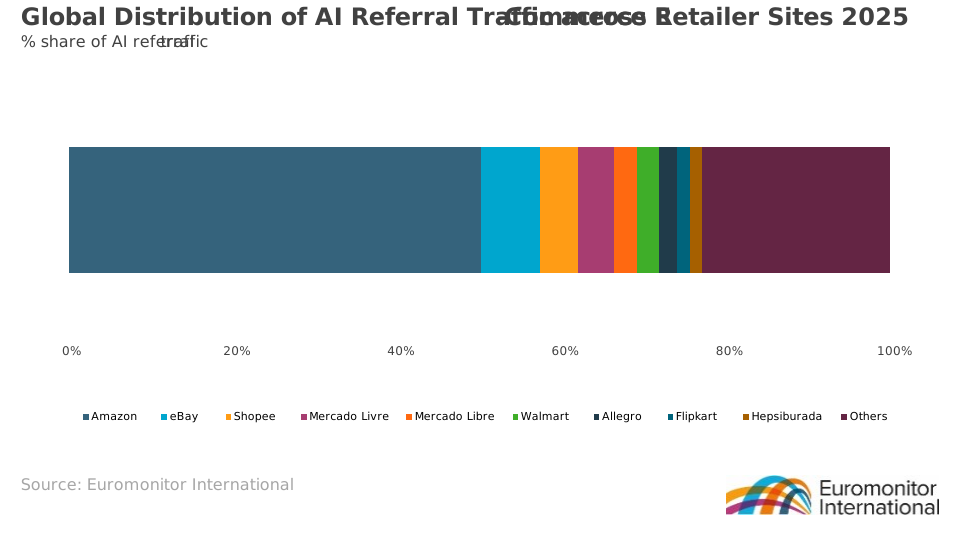
In 2025 and 2026, marketplaces dominated AI-led product referrals, representing eight of the top 10 e-commerce destinations recommended by GenAI platforms. Amazon alone captured 50% of AI-driven referral traffic to e-commerce retailers during 2025.
Source: Euromonitor International
The advantage extends beyond scale. Product pages on marketplaces carry the signals agents need to interpret products and make a recommendation, eg assortment breadth, pricing, reviews, delivery, seller credibility, availability, promotions – all assembled in one place, in a consistent structure and in enormous volume. While AI changes the interface through which consumers discover products, the signals determining the recommendation still sit inside the marketplace ecosystem.
Marketplaces could disappear without disappearing
The paradox is that the better marketplaces become an information source, the easier it is for an AI interface to extract that value without recreating the marketplace experience. Amazon, with the strongest position, is most exposed to external agent disruption.
Consider two shopping journeys. One, the consumer asks an AI assistant which running shoes to buy. The assistant evaluates the options, recommends a pair and sends the shopper to Amazon. AI influences the product choice, but Amazon still owns the final shopping environment, where the consumer can see competing products, sponsored placements, and reviews before purchasing. Two, the shopper tells the agent: “Find the best running shoes for me under GBP120 and order them.” The agent compares products and retailers, decides Amazon offers the best combination of price, reviews, availability and delivery, and completes the transaction. Amazon still wins the sale, processes the payment and fulfils the order, but the shopper never meaningfully visits Amazon. It retains the revenue but risks losing the basket, the discovery power and the advertising inventory.
This separation may happen even without AI platforms trying to own checkout, signalled by Anthropic’s new commerce-agent blueprint. Anthropic has released open-source reference architectures that allow businesses to build Claude-powered shopping and merchant assistants – as well as customer-facing shopping assistants. These tools can support product search, comparison, catalogue interpretation and basket construction. Essentially, Anthropic is providing the intelligence layer and the architecture connecting the commerce journey, while leaving payments to retailers and partners such as Visa and Mastercard.
Most shoppers still leave the AI interface to finish a transaction.
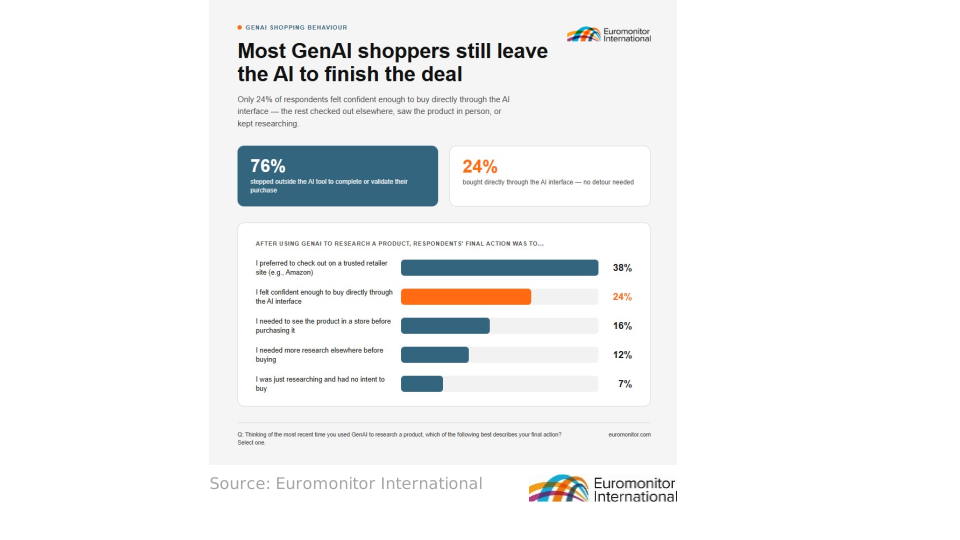
Per Euromonitor’s Voice of the Consumer: Digital Shopper Survey, fielded March 2026, only 24% of GenAI shoppers felt confident enough to complete a purchase directly through the AI interface. The majority still left the AI environment to complete the purchase.
Agentic commerce could unbundle the commerce stack
The wider implication is that e-commerce may move from a model built around destinations to one organised across three distinct layers: intelligence, transaction and fulfilment. The intelligence layer interprets consumer intent, compares products and shapes the consideration set. The transaction layer manages payment, authorisation and checkout. The fulfilment layer ensures the product reaches the consumer. Historically, marketplaces combined these functions in one consumer-facing environment, but agentic commerce means they could become increasingly distributed – both a threat and an opportunity for marketplaces. The competitive question therefore shifts from who owns the storefront to who controls the most influential parts of the commerce journey.
Download our reports, The State of Marketplaces in FMCG E-Commerce in 2026, for in-depth discussion on the performance of marketplaces, and The AI Visibility Gap: How Generative AI is Redefining Brand Discovery, to understand the dynamics of brand discovery in an AI-driven world.