
Retail competition’s next phase will be shaped by how effectively retailers influence demand, conversion and loyalty across an increasingly connected journey. Discovery, conversion and speed are becoming competitive battlegrounds as technology reshapes how demand is created and captured. GenAI, social commerce and quick commerce are opening new routes to consumers, forcing retailers to rethink how they earn and sustain loyalty, not just how they sell.
I will be exploring these themes at the FT Future of Retail in October and discovering how the industry is responding to these shifts, which are gaining traction, and which may prove to be more hype than substance.
Discovery no longer driven by search alone
For much of the digital era, retailers have competed for visibility within a search-led discovery model. That model is now being disrupted as AI begins to shape which products are surfaced, assessed and considered. The scale of this shift is becoming visible: Euromonitor retail data show inbound referral traffic from GenAI platforms to retail product pages rising 304% in 2025, compared with 40% growth from all other sources.
In AI-led discovery, the quality of information can determine which products are surfaced and recommended. Attributes, specifications, pricing and availability are no longer just operational details, they can shape consideration before conversion even begins. The implication is clear: data quality is becoming a source of commercial advantage.
Social commerce comes of age
AI is making product discovery more personalised and targeted, while social commerce is turning content and creator influence into new sources of demand. Global social commerce sales are forecast to increase 16% in constant terms in 2026, driven by platforms such as TikTok Shop that combine content, discovery and purchasing in a single environment. The player is already scaling rapidly in the US, with year-on-year sales up 120% in 2025 and K-beauty sales rising 132% over the same period.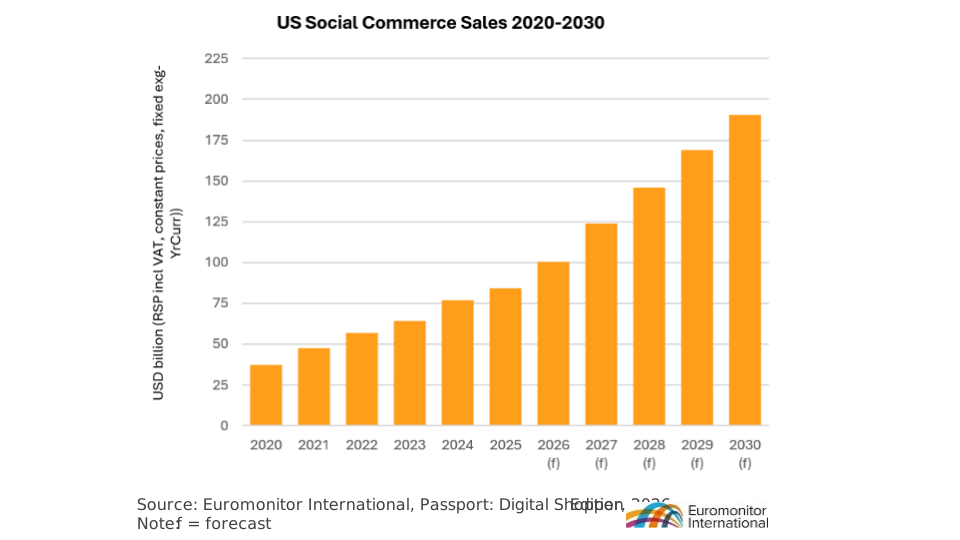
The commercial value lies in how effectively social influence translates into purchase. Creator content can shape product consideration as well as generate awareness, giving retailers a greater role in influencing choice earlier in the journey. The strategic challenge is to understand which creators, content and propositions have the strongest effect on conversion and how that effect varies across consumers and categories.
Fast and frictionless
Quick commerce is equally resetting the economics of convenience. Leading brands such as Blinkit, Amazon, Walmart and Alibaba are already scaling sub-30-minute delivery beyond grocery, extending rapid fulfilment into a broader range of retail categories. Amazon Now illustrates the scale of this shift, offering 30-minute delivery across 80 US municipalities, as of July 2026.
Network density will increasingly determine which retailers can compete effectively on speed. The effect will be greatest in high-frequency, time-sensitive categories, where faster delivery can influence retailer choice and purchase frequency. For retailers without comparable infrastructure, the strategic question is where speed is valuable enough to warrant investment.
Loyalty becoming an intelligence system
The role of loyalty is also changing, from recording customer behaviour to anticipating and influencing it. First-party data, combined with predictive and agentic capabilities, gives retailers greater scope to identify intent and act on it through more relevant offers, recommendations and experiences.
The shift is already visible. In April 2026, UK supermarket Tesco partnered with Adobe to apply AI to its Clubcard loyalty data, using it to better understand customer needs and personalise offers, recommendations and content. Australian department store Myer has taken a broader approach, embedding AI and machine learning into MYER one to personalise member experiences and inform how the programme engages customers and delivers benefits.
The strategic implication is significant: loyalty can move beyond rewarding transactions to shaping what happens next. Its value increasingly lies in turning customer insight into commercial action, linking what retailers know about customers with the decisions they are trying to influence.
The retail reset
These shifts point to a fundamental change in where influence sits across the purchase journey. Algorithms drive discovery, creators influence consideration, while fulfilment and loyalty increasingly determine conversion and retention. The result is a redistribution of influence across the purchase journey, and a shift in where retailers create and capture value.
The retailers best positioned over the next five years will be those that recognise the common shift across these developments: influence over the customer decision is becoming more distributed. Advantage will increasingly come from identifying intent earlier, anticipating it more precisely and acting on it faster. The algorithm is not replacing retail, it is changing where influence sits and who earns the next purchase.
To learn more about the key themes impacting retail and loyalty, read our reports, New Concepts in Retail, and Top Five Trends in Loyalty in 2026.