
Asian cuisine has moved into the mainstream of global food culture driven by travel, cultural evolution, and globalisation.
Notably, brands that first established credibility among diaspora communities have found a more reliable path to mainstream consumer trust than those pursuing mass-market entry without that foundation. The real growth prize lies beyond ethnic enclaves, however.
Source: Euromonitor International
Between 2020 and 2025, Asian restaurants outpaced overall restaurant value sales growth in every region, while nearly two in five non-ambient ready meals sold globally are now Asian dishes. It is critical for brands to convert this success into long-term growth engines while balancing authenticity with flavour quality and localisation. It is also crucial to embrace storytelling with subtlety and respect.
Asian Businesses Are Scaling Operations Rapidly
In a high-cost, highly competitive environment, brands that have invested in scalable operating models, while simultaneously building in mechanisms for consumer customisation, are outperforming peers across both foodservice and retail.
Haidilao, ranked fifth among full-service restaurants globally in 2025 (value sales) and the only non-American brand in the top ten, has demonstrated that a highly personalised dining experience, built on attentive hospitality and co-creation at the table, can be standardised and scaled internationally. In a contrasting model, Luckin Coffee climbed from 20th to 4th rank in cafés and bars globally between 2020 and 2025. Luckin leverages app-based ordering and tech-driven operations to deliver volume and disrupting the category by emphasising speed-orientated efficiency that can still allow customised orders that builds on core menu items.
Building modular product architectures and operationally standardised formats that still allow consumers to co-create or customise is the scalability model best suited to current market conditions.
Authentic Flavours Balanced with Accessible Formats
Consumer adoption of unfamiliar cuisines is typically anchored by specific sensory experiences, from the intensity of heat to the comfort of a chewy texture. These craveable characteristics serve as the entry point for trial and the basis for repeat purchase. Brands that identify and protect these sensory anchors, while building modular, convenience-oriented product formats around them, are best placed to convert occasional trial into habitual consumption.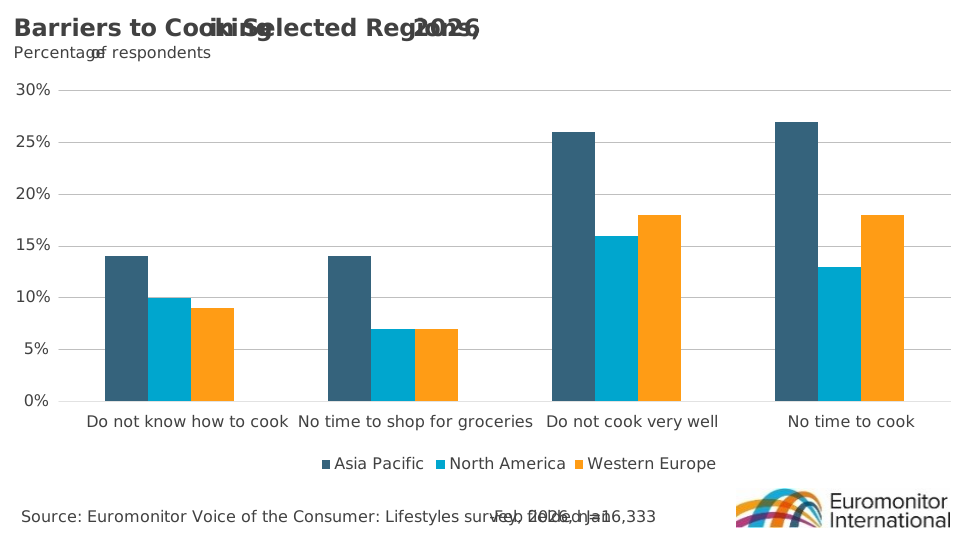
Market Leaders Build Familiarity via Cultural Channels
Asian entertainment and media have proven to be effective catalysts for consumer curiosity about Asian food. Brands that align with these cultural touchpoints through influencer partnerships, digital content, or association with popular entertainment formats can reach consumers who might otherwise find certain ingredients or dishes unfamiliar. Building a credible social identity and moving distribution progressively into mainstream retail channels enables brands to reach broader audiences at scale, in a cost-efficient manner relative to conventional advertising.
Asian Cuisine is a Gateway to Long-Term Growth
The broader operating environment is becoming more competitive. Global foodservice sales growth is forecast at 1.8% CAGR between 2025 and 2030, a notable deceleration from 6% in the prior period (both in constant terms, fixed exchange rates).
Against this backdrop, the continued expansion of major Asian cuisines like Korean, Chinese, Indian, and Thai into ready meals, sauces, and snacking formats represents one of the more significant growth opportunities available to food companies over the coming five years. Yet, as leading brands continue to consolidate share in packaged food, clear differentiation and connection with consumers are essential.
Brands that invest now in the foundations of operational scalability, consumer accessibility, and cultural relevance will be well positioned to capture a disproportionate share of that growth.
Learn more about the rise of Asian cuisines and where growth opportunities lie in our report, Asian Cuisine, Global Appetite to identify market leaders and high-growth segments.