
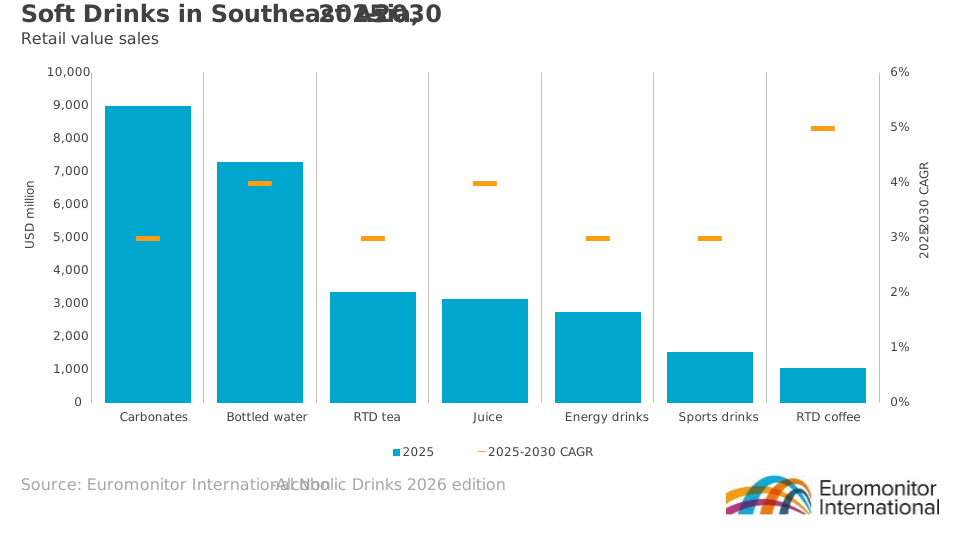
Southeast Asia remains an attractive region for Chinese beverage companies to expand and grow their global footprint. Following the footsteps of Chinese coffee and tea shops like Luckin and Chagee, beverage players like Eastroc Beverages and Nongfu Spring are expanding into Southeast Asia, becoming global beverage brands. Retail value sales of soft drinks in Southeast Asia will record a 3% CAGR over 2025-2030, hitting USD29.7 billion in 2030.
Chinese brands’ localisation strategy requires more than product adaptation
The success of Chinese beverage brands is not driven by flavour innovation or product positioning alone. Sustainable growth requires brands to localise their entire operating model, including distribution partnerships, supply chain infrastructure, manufacturing capabilities, and marketing strategies. Winning in the region depends on balancing global brand strengths with deep local market relevance.
Chi Forest offers a compelling story. In 2022, its Zero Sugar Sparkling water penetrated Indonesia by launching into major convenience stores, Indomaret and Alfamart (44,953 retail outlets). Its success is attributed to its appeal to local consumers, who do not like excessive sugar in carbonates, alongside its active social media marketing. Furthermore, its production facility in China secured halal certification from Indonesia’s Halal Product Assurance Agency for its products, building local consumer trust. Its localisation success and appeal to consumers’ health consciousness meant that it was easier to launch its iced teas in June 2025.
Similarly, Eastroc Beverage has invested in local production facilities in Indonesia and Vietnam since 2024, while establishing a dedicated subsidiary in Malaysia. These investments strengthen supply chain resilience, improve speed-to-market, and provide local autonomy to respond effectively to market dynamics. Eastroc's adaptation of its flagship Dongpeng energy drink in Malaysia is a key example. The company launched local packaging formats and targeted blue-collar consumers through local messaging. Combined with an accessible price point and broad distribution through leading convenience retailer 99 Speedmart, the strategy has enhanced brand visibility and accelerated consumer adoption, resulting in 9% volume growth of energy drinks in Malaysia.
Furthermore, packaging localisation is also increasingly becoming a strategic growth lever by Chinese beverage brands. Nongfu’s Cha Pi's growing popularity in Malaysia demonstrates how localising the brand into English can unlock organic word-of-mouth and social media advocacy, helping brands scale efficiently while reducing reliance on sustained marketing expenditure.
Leveraging a broader beverage portfolio is key to capture new consumption occasions
Chinese beverage brands cannot simply rely on a single hero brand for success. Instead, they leverage multiple brands to succeed and capture new consumption occasions. For instance, Eastroc introduced Water Boost as a hydration-focused offering to Southeast Asia, building on its success in China. This is evident in markets such as Thailand and Vietnam, where Eastroc launched Water Boost tapping on hydration rather than energy considering the stiff competition in these markets. By strategically prioritising faster-evolving categories like sports drinks, this highlights Eastroc’s winning strategy that is aligned with local consumer demand and competitive intensity.
Beyond exporting success: Building local relevance to win Southeast Asia
Southeast Asia’s soft drinks market requires a strategic blend of localisation and agility.
While Chinese brands have gained ground by adapting products and leveraging local distribution, they have yet to achieve a strong positive reputation and consumer trust.
Source: Euromonitor International
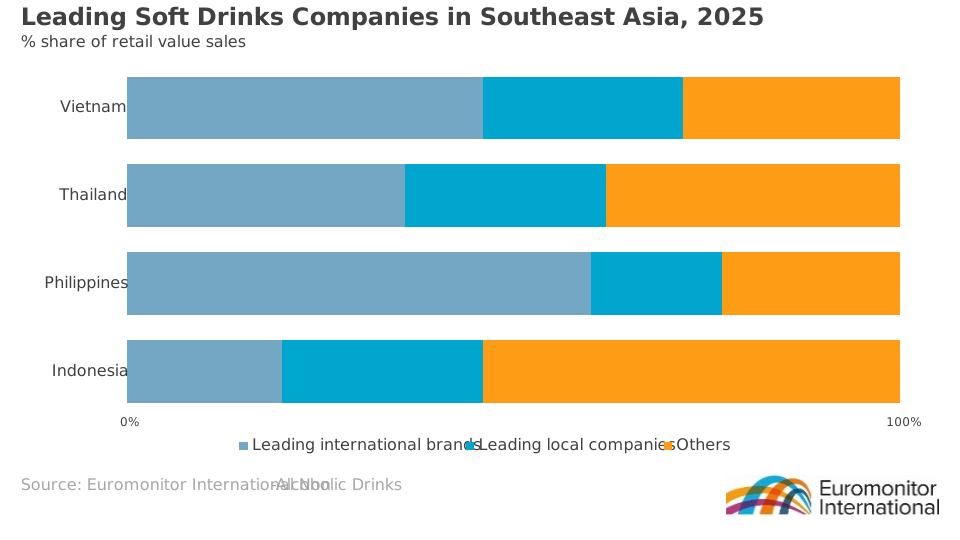
On the other hand, incumbents like Coca-Cola, Pepsi and Nestlé maintain dominance in the Philippines and Vietnam through continuous innovation, consumer trust and extensive channel penetration.
Read our blog, The Rise of Chinese Brands is Reshaping Southeast Asia’s Consumer Landscape, and the white paper, How are Chinese brands disrupting the Southeast Asia market?, for more analysis on how Chinese brands are expanding into Southeast Asian markets in food and other industries.