
Chinese brands are becoming increasingly embedded in Latin America’s consumer landscape, and fashion offers one of the clearest examples of this transformation. What began largely as a trade story is increasingly becoming a brand and retail story, led by digital-first players such as Shein. Their growth is not only creating new competitors but changing expectations around price, speed, assortment and digital engagement.
China is already deeply embedded in Latin American fashion
China’s importance to Latin American fashion starts well before the rise of Chinese consumer brands. Chinese-made apparel already accounts for a significant share of imports across the region. In 2025, China represented 71% of apparel imports into Chile, 57% in Peru and more than half in Brazil and Argentina. Even in Colombia and Mexico where its share its lower, China accounted for 41% and 35%, respectively.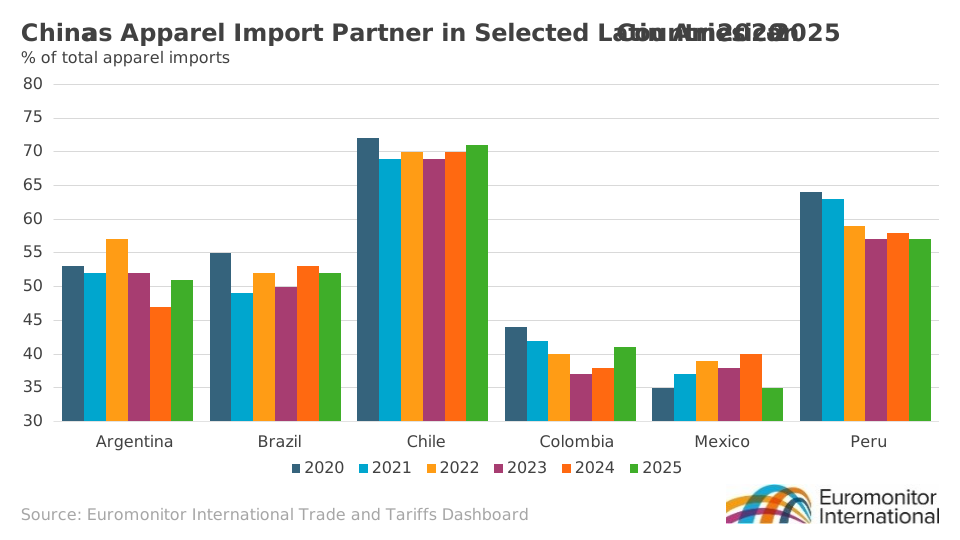
This established supply relationship has created a strong foundation for Chinese companies to move closer to consumers. Cross-border e-commerce has accelerated the shift, allowing companies to bypass parts of the traditional retail and distribution model and respond rapidly to demand.
The result is an important transition; China is no longer simply supplying the products sold by Latin American fashion retailers, Chinese companies are increasingly competing for consumers themselves.
Shein shows how quickly the competitive landscape can change
Few brands illustrate this shift better than Shein, owned by Roadget Business Pte Ltd. Its combination of ultra-competitive prices, wide assortment, rapid trend response and mobile-first shopping has resonated particularly strongly with younger and value-conscious consumers.
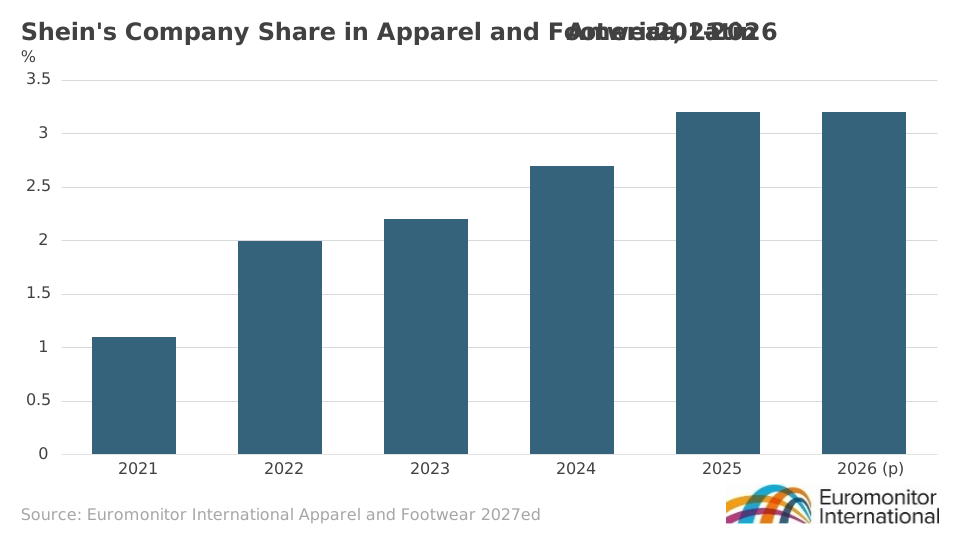
Within just five years, the company became the third-largest apparel and footwear player in Latin America in 2025, with particularly strong positions in Brazil, Chile and Mexico.
Source: Euromonitor International
But Shein’s strategy is evolving. Increasing regulatory scrutiny and tariffs are making the original cross-border model more difficult to sustain. Brazil’s introduction of the “taxa das blusinhas” and the elimination of the tax exemption for international orders costing less than USD41 in Chile, for example, increased the cost of low-value imported parcels and weakened Shein’s price advantage.
Rather than retreating, Shein accelerated localisation. It committed BRL750 million to modernising Brazil’s textile supply chain, partnered with hundreds of Brazilian factories and expanded its marketplace to local sellers. Local production and fulfilment help reduce tariff exposure while shortening delivery times and increasing local relevance.
Shein’s experience therefore points to the next stage of Chinese fashion expansion in Latin America: moving from low-cost cross-border disruption towards a hybrid global-local model.
Incumbents respond with their own competitive advantages
For established fashion players, competing with Chinese platforms purely on price is unlikely to be sustainable. Instead, local and regional retailers are focusing on areas where they retain structural advantages: proximity to consumers, cultural relevance, physical retail networks and local supply chains.
Brazilian retailer Riachuelo provides one example. Alongside investing BRL35 million in machinery and supply chain optimisation, it has strengthened its Brazilian identity through more concept-driven collections and culturally relevant initiatives, including designing Team Brazil’s travel and Opening Ceremony uniforms for the summer Olympics in Paris.
Mexican fashion retailer Cuidado con el Perro offers another model for competing with Shein. The brand targets a similar young, value-conscious consumer, combining accessible prices and trend-led fashion with the advantage of an established physical retail network and stronger understanding of local tastes. Rather than trying to match Shein’s enormous online assortment, its strength lies in bringing fast-fashion trends closer to consumers through locally relevant products, stores and omnichannel presence. This demonstrates how regional brands can adopt some of the speed and value principles behind Shein’s success while leveraging proximity and physical retail as differentiators.
Chinese fashion players’ success will increasingly depend on more than price, as localisation and digital execution become critical. For incumbents, the opportunity is to combine speed and competitive value with local relevance, consumer trust and omnichannel capabilities, building advantages that Chinese competitors cannot easily replicate.
Download our whitepaper, The rise of Chinese brands in Latin America, for in-depth analysis on the growing presence of Chinese brands across industries in the region, case studies and strategic recommendations.