
Today, the apparel and footwear retail landscape is entering a more complex, cautious and uneven phase, shaped by macroeconomic volatility, geopolitical disruption, AI-led shifts and changing consumer values. In this context, market players can no longer rely on standard omnichannel models or price-led propositions alone.
Value is increasingly tied to the overall experience
The security crisis in the Strait of Hormuz and wider geopolitical instability have prompted downward revisions to global GDP growth and upward revisions to inflation, and the global outlook to 2030 remains fragile, with apparel and footwear forecast to grow at a slow 0.9% CAGR in constant terms, equivalent to 3.6% in current terms, as inflation, climate crisis, cost pressures and weakened consumer confidence weigh on discretionary spending while unpredictability has become the operating norm for the industry.
In this context, consumer behaviour is becoming more polarised and discerning, with shoppers across income brackets demonstrating heightened price sensitivity, but not necessarily choosing the cheapest option. Value is increasingly tied to the overall experience: product relevance, emotional connection, convenience, personalisation, community and service all matter.
The squeeze on household budgets means consumers are researching more, comparing more and shopping more strategically.
Source: Euromonitor International
This is accelerating polarisation across the market, with mid-tier brands and retailers under pressure while off-price, private label, budget-friendly fast fashion, high-end premium players and performance-led brands are better positioned.
Regionally, growth prospects are uneven. Asia Pacific is expected to be the fastest-growing region for apparel and footwear through to 2030, while Latin America and Australasia also show dynamism. North America and EMEA remain important contributors to global value sales but are more mature and competitive. For brands and retailers, this creates a dual strategic challenge: capture growth in faster-expanding emerging markets while protecting scale, profitability and premiumisation in mature Western markets.
The channel story is no longer simply about e-commerce replacing stores
E-commerce now accounts for more than 32% of global apparel and footwear value sales, but its growth has slowed from the post-pandemic surge due to maturity in key markets such as China, the US and Europe. Growth remains stronger in emerging markets, particularly India, Latin America and Southeast Asia, where digital adoption and fashion demand are still expanding thanks to a mix of growing middle class and disposable income, combined with development of e-commerce infrastructure through legal reforms and private and public investments.
Yet, offline retail still represents the majority of global apparel and footwear retail value, underlining the continuing relevance of physical stores. Today, physical stores still offer benefits that online channels cannot fully replicate, including fit assessment, try-ons, repairs, sensory engagement and high-touch service. More importantly, physical retail is increasingly being reinvented as a platform for “store theatre” – using live demonstrations, displays, events, immersive merchandising and sensory elements to turn stores into destinations that strengthen brand storytelling and loyalty. This supports a broader shift towards “third spaces” – environments that exist beyond home, work and stores – and community-driven retail, where fashion businesses create environments that offer inspiration, entertainment and emotional connection rather than purely transactional selling.
Two transformative forces stand out for future retail strategy: AI and resale
AI-powered search, generative AI and agentic AI have the potential to reshape how consumers discover, compare and purchase apparel and footwear. As AI agents increasingly influence shopping journeys, retailers will need to ensure that pricing, product, availability and inventory data are structured, accurate and machine-readable. Those that fail to make their data accessible and reliable risk being excluded from AI-driven discovery and recommendation pathways. 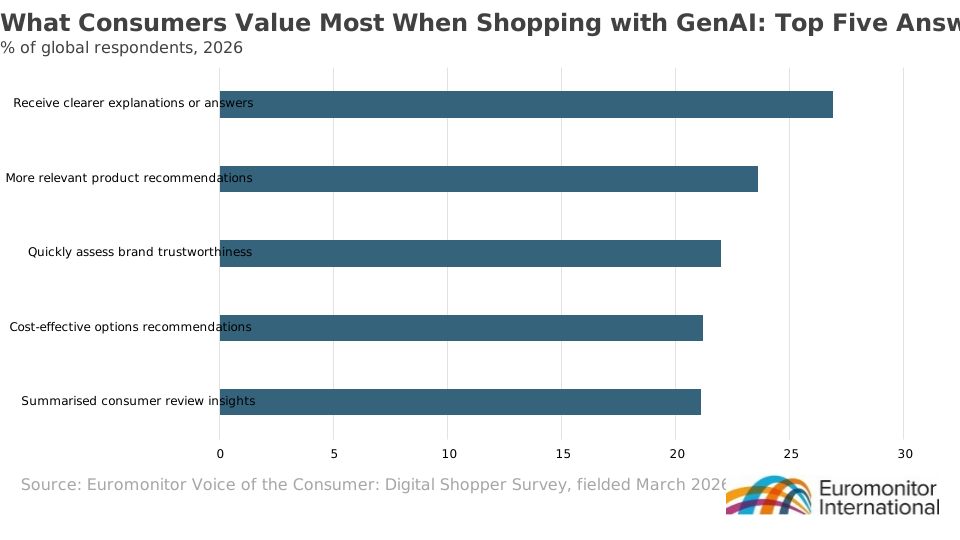
At the same time, second-hand and pre-loved culture is becoming mainstream in Europe and the US and gaining traction elsewhere, creating both competition and partnership opportunities between brands, retailers and resale marketplaces. As second-hand platforms are increasingly positioning themselves as curators and trendsetters, not just low-cost alternatives, brands need to develop their own resale strategies or partnerships to unlock cultural relevance, build loyalty and unlock new revenue streams.
Conclusion
In a complex and fast-moving trading environment, apparel and footwear brands and retailers must build resilience across pricing, sourcing and market portfolios while deciding where to play in a more polarised landscape: accessible value, premium performance, lifestyle ecosystems, circular models, digitally enabled convenience or experiential retail. The winners will be those that combine digital capability, strong execution, relevant product assortments, community engagement and emotionally resonant omnichannel experiences.
To know more about transformative trends and winning retail strategies in the global apparel and footwear industry, read our briefing, Where Consumers Shop for Apparel and Footwear.