
Latin American home care is evolving in response to economic pressure, global uncertainty and changing consumer habits. Like elsewhere in FMCG, brands are being challenged to deliver value in relevant and compelling ways for today’s consumers. What matters most when it comes to household cleaning? What drives product choice? And are current value propositions keeping pace with consumer needs? In this context, affordability, scent and time-saving performance are increasingly important in shaping demand across the region.
Consumers expect more value from every purchase
Latin America remains relevant in global home care, but growth is increasingly difficult to capture. In 2025, its market size was USD26.5 billion, representing 13% of global sales. However, value sales declined by 1.7% in 2025, and are expected to post a modest 0.3% CAGR during 2025-2030.
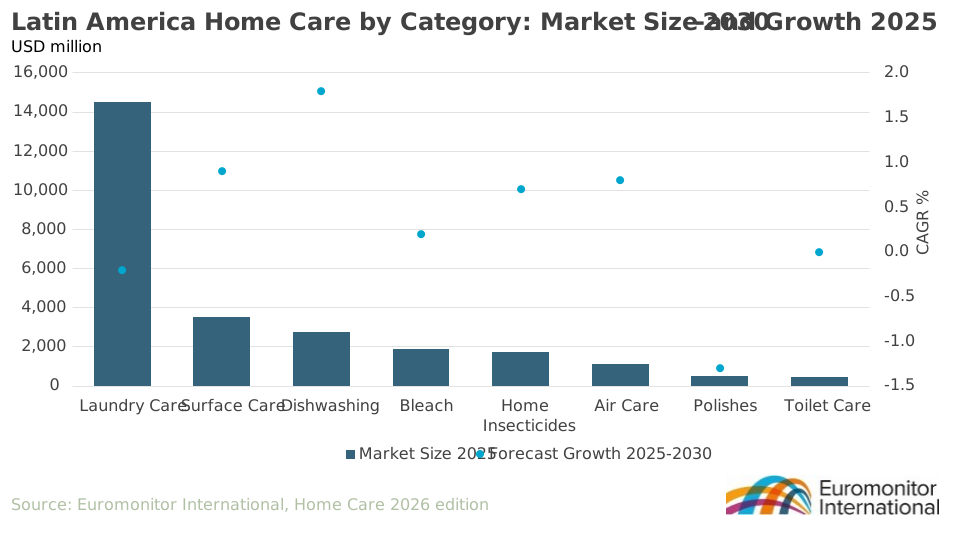
Consumers continue to buy, but evaluate each household cleaning purchase more carefully to justify its place in the budget. Cleaning efficacy is no longer enough: products must perform, stretch, feel better and adapt to more demanding routines.
This shift is happening in a demographically diverse region. Population ageing, fewer households with children, more single-person households and Generation Z’s influence mean household cleaning no longer responds to one single consumer profile. Needs vary by life stage, household size, digital habits, price sensitivity and available time.
Affordability is more than low price
With tighter household budgets, affordability becomes central. But in home care, affordability does not simply mean low price, but a broader value equation where consumers weigh price, yield, format, performance and trust in the brand.
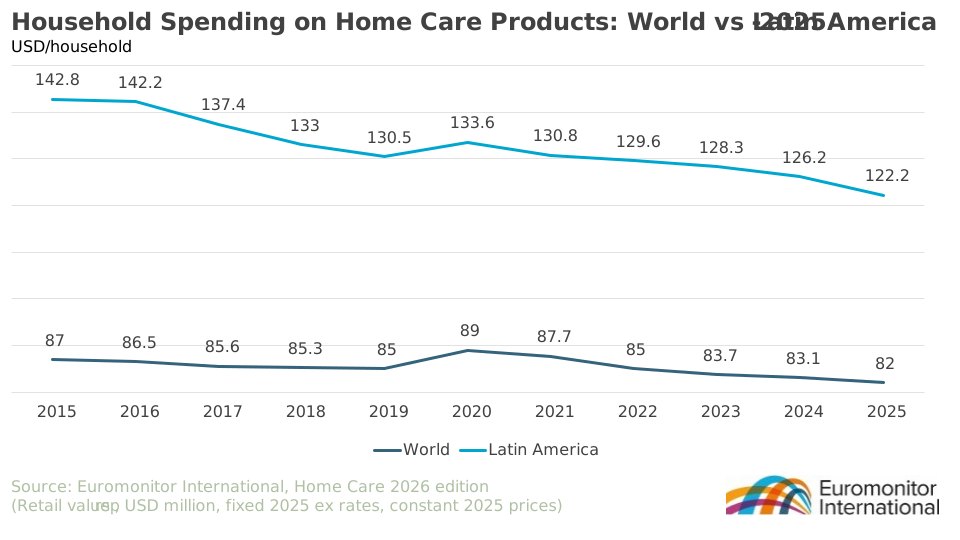
Average household spending on home care in Latin America has decreased since 2015, reinforcing the need for propositions that make value easier to understand. In this environment, concentrates, refills, smaller packs, sachets and family-size formats can all respond to different needs, provided the value promise is clear.
Private label’s expansion also shows that consumers are willing to explore alternatives when they perceive a strong balance between price and performance. In Colombia, for example, private label has a high share within home care, supported by the development of hard discounters. However, private label is no longer competing on price alone, but increasingly on performance and convenience.
Scent turns cleaning into an experience
Scent has moved beyond being a secondary attribute. In cleaning products, fragrance works as a visible-invisible signal of efficacy, confirming freshness, care and a sense of cleanliness after use. For many consumers, cleaning is not complete when the surface looks clean, but when the home also feels clean.
This creates an important opportunity for differentiation and value creation. Fragrance connects home care with codes that are closer to personal care: choice, wellbeing, identity and sensory experience. It is no longer just about “smelling good”, but about building sensations of calm, freshness, comfort and care within the home.
Examples such as partnerships between cleaning brands and fragrance-led brands show how scent can become a platform for selective premiumisation. In fabric softeners, surface cleaners or air care, olfactive innovation can transform a household task into a more emotional and memorable experience.
Efficiency responds to more compressed routines
The third axis is efficiency. Consumers seek products that do more with less effort, fewer steps and less time, especially among households where work routines, commuting and domestic responsibilities compete for the same limited time.
In laundry care, the move towards shorter cycles and cold-water washing raises the performance bar for detergents. With less contact time and lower temperatures, formulation must compensate by delivering stronger results from the start of the wash. Efficiency, therefore, is not only about speed; it is about visible performance under more demanding conditions.
The same applies to surface care, where multipurpose products and solutions designed for specific cleaning missions promise to reduce steps, avoid rework and make daily cleaning easier. In this context, consumers are not only buying cleanliness – they are buying time back.
The new direction of home care
Affordability, scent and efficiency summarise a new way of understanding value in home care. The opportunity for brands is not only to clean better, but to make every purchase feel more justified, because the product lasts longer, feels better or simplifies everyday life.
In today’s Latin American market, “accessible, scented and time-saving” may well become a roadmap for more relevant innovation, connecting functional performance with consumers’ real priorities.
For deeper insight into the trends reshaping the global home care industry, read our report, Top Five Trends in Home Care.