
Sustainability sells, just unevenly. Global sales of sustainable products reached USD886 billion in 2025, growing at a 6.7% CAGR (2020-2025) and outpacing conventional products by 1.3 p.p. Tissue and hygiene tells a more modest story. Sustainability sales reached USD30.2 billion - the lowest of the 11 FMCG industries Euromonitor tracks - with a 4.1% CAGR (2020-2025), outgrowing conventional products by just 0.6 p.p.
Growth remains narrow, favouring brands that recognise a generic claim alone is no longer enough to stand out. The brands pulling ahead are not abandoning Natural and Environmentally Friendly - they are reinforcing those positions with specific, certified proof.
Generic claims are losing ground as proof gains importance
Across four commercially important T&H markets - China, Brazil, India and the US - Natural and Environmentally Friendly remain the most common sustainability claims on the digital shelf. Yet their share is slipping, pointing to the growing importance of substantiation: broad claims alone offer less scope for differentiation, while specific evidence gives brands a clearer basis to compete.
Retail tissue is central to this shift. It is the largest T&H category by sales and the most sourcing-intensive, making responsible forestry critical to compliance and business resilience. Claims such as FSC (Forest Stewardship Council), Responsible Sourcing and No Bleach connect sustainability to sourcing and production practices. In Brazil, Natural fell more than seven p.p. of retail tissue shelf presence between Q2 2024 and Q2 2026. While specific claims are gaining ground. FSC rose 1.4 p.p. in US retail tissue, while No Bleach gained 2.3 p.p. in India. The opportunity is twofold: prove responsible sourcing and reassure consumers about how products are made.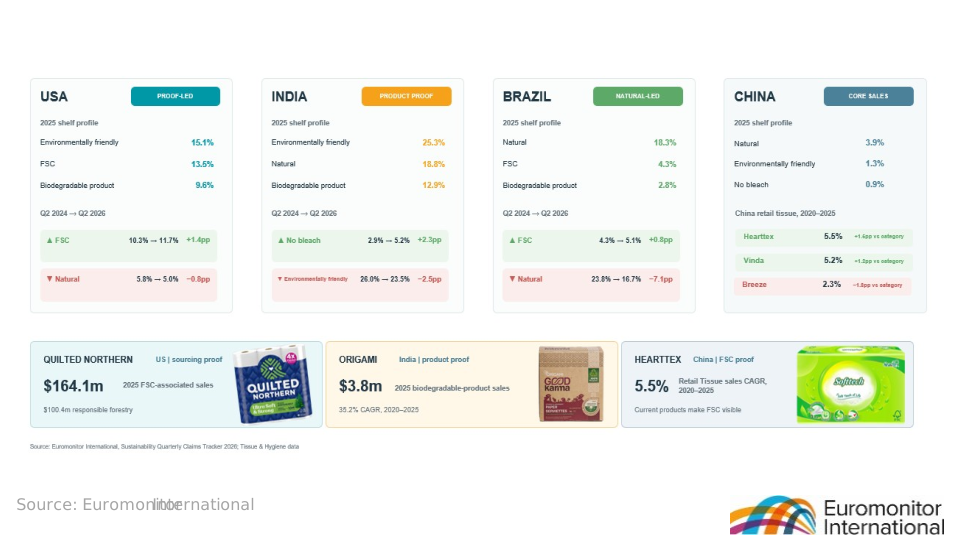
The direction is similar, but the pace and starting points differ. Brazil is moving away from generic claims fastest, while India and the US are shifting more gradually. China presents a different landscape: Natural appears on just 3.9% of retail tissue shelf space. Brands should therefore tailor the claims mix and supporting evidence to each market, rather than relying on a single global approach.
The winning move: Anchor on generic, reinforce with proof
This shift is significantly relevant in Tissue and Hygiene, where health and safety are primary consumer motivations. When something touches your skin or your baby’s skin, “Good for the planet” feels like a bonus, as “Free from harmful chemicals” is the purchase driver.
Euromonitor´s consumer survey data backs this up. Among global buyers of menstrual care products, 26% look for hypoallergenic or sensitive skin-friendly features, while 20% prioritise eco-friendly materials. Performance and safety come first; sustainability is the layer on top. That is why reassurance claims are rising fastest where they have room to grow. For example, No Chemicals already reaches 27% of India’s wipes shelf, and No Dye reaches 19% of US menstrual care.
The brands converting this into sales are those reinforcing their generic positioning with evidence that speaks directly to those priorities. Honest’s USD145 million in US sustainable diaper sales rests on FSC-certified fluff pulp and OEKO-TEX certification. Quilted Northern built USD164 million in FSC-associated sales by making certified sourcing visible on pack and on shelf. Both show how smaller and medium brands can position effectively: keep the Natural anchor but make proof the story.
Reassurance and certification do the work that “eco-friendly” on its own no longer can.
Source: Euromonitor International
Sustainability investment as a key part of the resilience strategy
The move from generic to specific claims is not only a marketing story. It is becoming a legal one. From August 2026, the EU’s Empowering Consumers Directive bans generic claims like “eco-friendly” unless backed by recognised proof. The US Federal Trade Commission’s Green Guides require the same. Brazil, India and China have each introduced evidence requirements of their own.
The commercial stakes are rising in parallel. In US diapers, sustainable products posted a 6.7% CAGR (2020-2025), while conventional products barely moved at 0.3%. Both compliance and growth are pulling towards claims that can be substantiated. A second, less obvious advantage, is that certified sourcing doubles as a supply chain hedge. FSC certification signals responsible forestry to consumers, but it also secures access to regulated raw materials as droughts, deforestation and water stress disrupt supply. A brand that can prove where its pulp comes from is protecting continuity, not just communicating values.
For T&H brands, the priority is to reinforce broad sustainability claims with specific proof. Reassurance addresses consumer priorities; certified sourcing supports resilience. Keep the positioning but make evidence the differentiator.
To see which claims are driving growth in your category and market, request a demo of Euromonitor’s Sustainability solutions.