
Generative AI is changing how consumers discover, compare and choose products. Globally, AI-driven referrals grew 302% in 2025, while every other source combined grew 40% - according to Euromonitor International, E-Commerce.
ChatGPT, Google Gemini and Perplexity are reshaping search, while retailer-led assistants such as Amazon’s Rufus, now integrated into Alexa for Shopping are bringing conversational and intent led discovery directly into commerce.
While the anxiety in the industry around the shift is real and brand leaders face several questions – it’s noteworthy that the impact will not be evenly distributed. To understand GenAI’s role, we need to look at product discovery through a consumer’s lens.
At the point of discovery – a consumer is trying to answer two questions
Product discovery, at its core, is driven by two implicit questions every shopper is trying to answer: how does this compare to the alternatives (the need for comparison), and am I making the right choice (the need for reassurance).
With this comparison-and-reassurance framework, four situations fall out.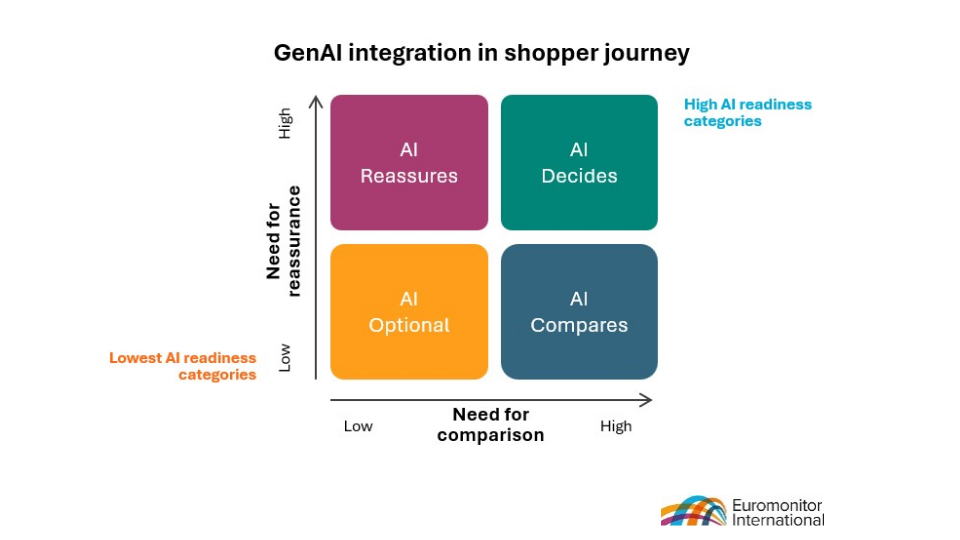
Mapped onto real shopping situations, the four quadrants become easier to recognise.
Where both needs are low –as in the case of a routine basics purchase, paper towels, bin liners - AI is basically optional. It might handle the reorder, but it isn't changing what gets bought.
Where comparison matters more than reassurance, AI compares. This is where it ranks and filters options against whatever criteria a shopper hands it. These are highly considered, but anxious purchases – such as choosing between protein powders or kitchen blenders on factors such as price of features.
Where reassurance matters more than comparison, AI reassures. Think of a first-time mom looking for an infant care product such as baby milk formula or suitable diapers. In this case, AI adds more context and adds the confidence on the safety and sensibility of the choice.
The greatest disruption emerges when shoppers face both a complex choice and a high perceived cost of getting it wrong. Consider a shopper looking for a skincare product for a specific condition or a supplement suited to an individual health concern. The shopper is no longer asking AI merely to retrieve information but to interpret their needs, assess competing claims and recommend a course of action. In effect, AI becomes a decision intermediary.
This is where it creates the most consumer value - but also where brand loyalty becomes most exposed.
Where it's actually showing up
Euromonitor put a version of this question directly to a live audience of industry practitioners, during the original briefing. Beauty was, unsurprisingly, the most common instinct in the room. The underlying data vindicates that instinct and puts a number on it.
In FMCG specifically, 45% of all GenAI referral traffic flows into Beauty and Personal Care alone, and another 28% into Consumer Health - together, three-quarters of all AI-referred discovery activity in the sector sits in just two categories.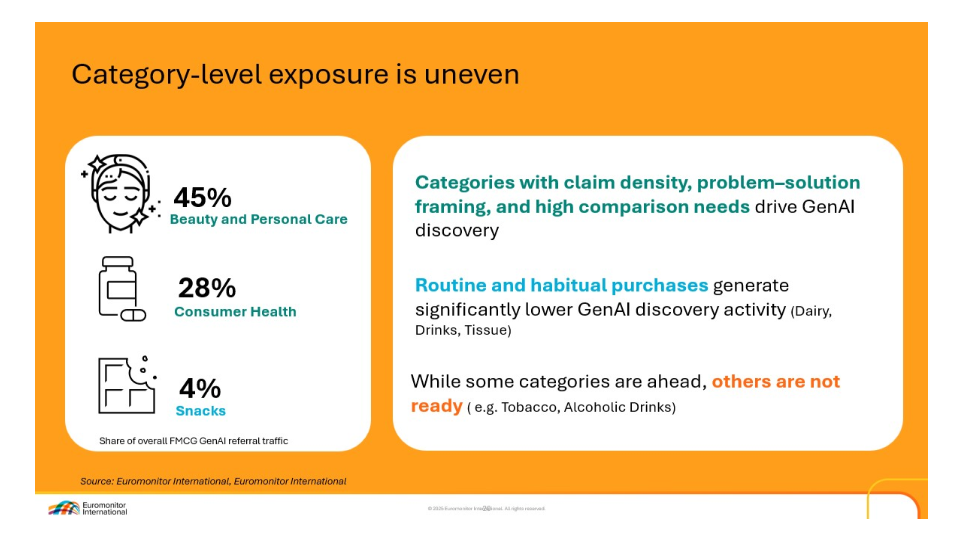
That split isn't random. Beauty and health are dense with claims, built around problem-and-solution framing, and loaded with exactly the comparison-and-reassurance need the framework describes - will this work for my skin, my situation. Snacks, dairy, drinks, tissue feature low deliberation, low anxiety about getting it wrong, and correspondingly little reason to hand the decision to an AI system at all.
Worth saying that this is not a rising tide lifting every category equally. GenAI-led discovery is reshaping some corners of consumer goods hard, and leaving others almost untouched — and, not coincidentally, the categories being reshaped are the ones where brand loyalty was already most fragile.
AI visibility is becoming binary
The implications become uncomfortable once a category moves into the high-comparison, high-reassurance quadrant. Analysis of more than 3,000 US skincare brands found that only 10–15% show up in AI referrals at all: AI discovery behaves less like a spectrum and more binary. A brand is either recommended, or it's functionally invisible.
Helena Rubinstein is the 15th-biggest skincare brand on earth by revenue. But based on referrals from an AI system, it ranks 1,531st. For every shopper who discovers the brand through AI, roughly three hundred discover Neutrogena instead.
Source: Euromonitor International
If your category sits anywhere near that top-right quadrant, the question worth asking isn't "do we have a content strategy." It's "do we actually know where we sit in AI-driven discovery today." Most brands don't, yet - and that gap is not only closing faster for some competitors.
For deeper insights and strategic guidance, watch the on‑demand webinar and insight– From search to conversation: How AI is rewiring the traditional shopper funnel | Euromonitor. Explore the data, category signals and strategic frameworks shaping the next era of commerce.