
Our first article, Why Southeast Asia Is E-Commerce’s Next Big Opportunity, sets out the scale of the region’s growth. Across the five markets where Passport now tracks marketplace sales - Indonesia, Malaysia, the Philippines, Thailand and Vietnam - retail e-commerce sales reached USD167.5 billion in 2025, up 19% from the previous year. The combined market is now more than 2.5 times its 2020 size.
Yet growth alone does not tell the full story. Understanding Southeast Asia means looking beyond how fast e-commerce is growing to understand where that growth is happening, which platforms are capturing it and where opportunities are emerging.
Marketplace competition is evolving
As e-commerce grows, brands reach shoppers more easily, and shoppers can complete purchases with less friction. As a result, online is no longer the home of occasional purchases. Routine categories and fast-moving consumer goods now carry real weight on the leading marketplaces.
Shopee continues to command significant sales across the five markets, even as TikTok Shop gains scale rapidly.
Between 2024 and 2025, TikTok Shop sales more than doubled across Indonesia, Malaysia, the Philippines, Thailand and Vietnam.
Source: Euromonitor International
Lazada adds another layer of competition across the region, while Tokopedia forms part of Indonesia’s distinct local marketplace landscape.
Behind these shifts sit different shopper habits. TikTok Shop’s rise reflects discovery that starts with entertainment. In Thailand and Vietnam, shoppers increasingly find products while scrolling short videos and can buy without leaving the app. In contrast, shoppers plan and wait for the right deal on Shopee and Lazada.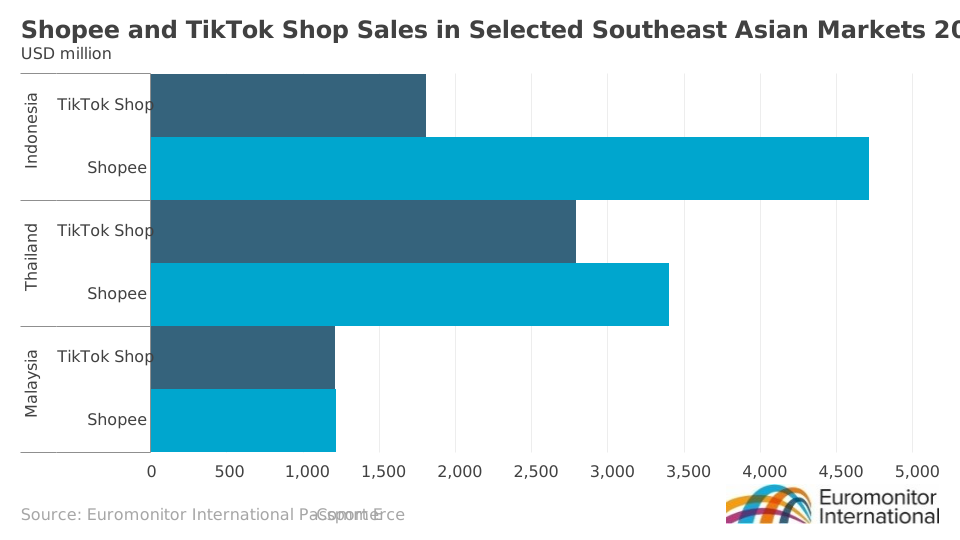
In Indonesia, Shopee remained more than twice as large as TikTok Shop in 2025. The gap is considerably narrower in Thailand, while in Malaysia, the two platforms recorded almost equivalent sales.
Understanding which platforms are gaining momentum is therefore only the starting point. How that momentum translates into competitive position across individual markets can provide brands with greater context on where to compete, benchmark performance and prioritise marketplace investment.
There is no single marketplace playbook across Southeast Asia
The competitive picture becomes even more locally nuanced when looking beyond Shopee and TikTok Shop. Lazada’s relative position also varies considerably across the region. In 2025, Lazada accounted for around 11% of FMCG sales across the covered marketplaces in the Philippines, compared with around 2% in Vietnam.
The same marketplaces operate across the region, but shoppers use them in different ways.
Deal-seeking is the common thread across the region, but what tips a purchase varies. During big sale days, Thai shoppers lean towards stocking up on everyday goods, while shoppers in Indonesia and Vietnam spend more time browsing and comparing. In the Philippines, cash on delivery remains deeply rooted, and the lack of a preferred payment option is a common reason for abandoned purchases.
Moving from market growth to better e-commerce decisions
For brands, the next step is understanding what is driving marketplace performance and whether the opportunity is relevant to their category.
Within FMCG, beauty and personal care provides a useful example. The category’s importance differs across platforms and markets, so the most relevant marketplace for a brand can depend as much on its category as on its market.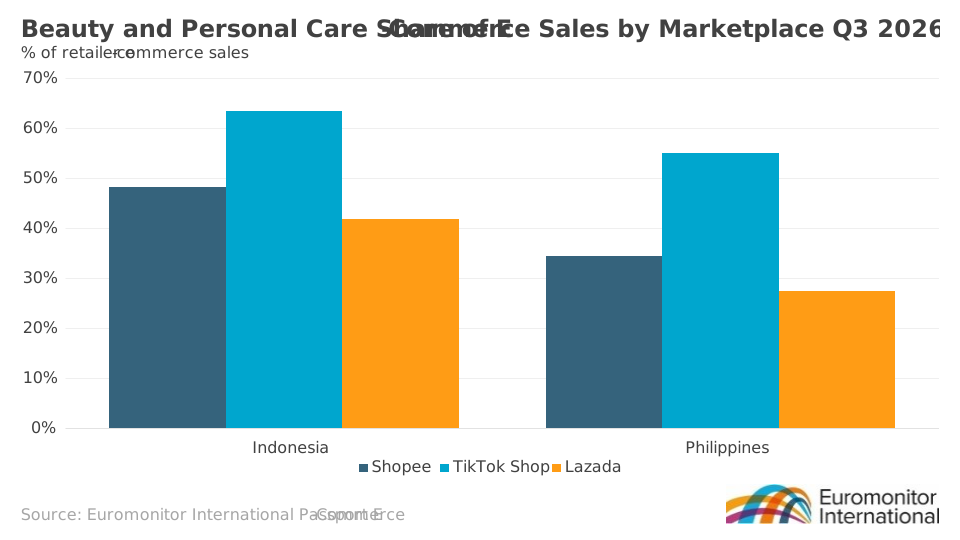
In Indonesia, beauty and personal care is important across the marketplace landscape, although it plays a particularly prominent role on TikTok Shop. The opportunity is therefore broad, rather than concentrated on a single platform.
The Philippines presents a different picture. Beauty and personal care is much more prominent within TikTok Shop’s sales mix than on Shopee or Lazada, creating a clearer distinction between platforms for brands competing in the category.
This added layer of detail moves brands from broad market questions towards more practical decisions: Which marketplace is most relevant to my category? How does that opportunity differ by market? And where might there be untapped potential?
Expanded Passport E-Commerce coverage across Indonesia, Malaysia, the Philippines, Thailand and Vietnam enables businesses to explore these dynamics in greater detail and turn regional growth into more informed, market-level decisions. Or read our report “The State of Marketplaces in FMCG E-Commerce in 2026”, to understand the marketplace landscape in 2026.
Note: Marketplace sales figures in this article reflect the 12 industries covered by Passport E- Commerce and do not represent total marketplace sales.