
Retail e-commerce across Indonesia, Malaysia, the Philippines, Singapore, Thailand and Vietnam reached USD172.5 billion in 2025, up 21% year on year. These six markets, referred to here as Southeast Asia, are about three times the size they were in 2020. They are home to more than 600 million consumers. As brands decide where to place their next big bet in Asia Pacific, Southeast Asia is hard to ignore. The harder task is understanding how its markets differ.
Southeast Asia claims a growing share of Asia Pacific e-commerce
Southeast Asia is small compared to China, which anchors Asia Pacific, but its share is rising. The six markets accounted for 6% of Asia Pacific retail e-commerce in 2020 and 9% in 2025. Most of that gain came between 2020 and 2022, when the pandemic pushed shoppers online. However, 2025 was a standout year: sales grew 21% in Southeast Asia against 11% in Asia Pacific.
That growth premium is not a one-off.
Retail e-commerce compounded at 23% a year over 2020 to 2025, against 13% for Asia Pacific as a whole.
Source: Euromonitor International
Forecasts point to the region continuing to outgrow its wider market. By 2030, sales are forecast to reach USD323 billion. That would lift the six markets' share of Asia Pacific retail e-commerce from 9% to 10%. For brands, that growth premium makes Southeast Asia more than a side bet within Asia Pacific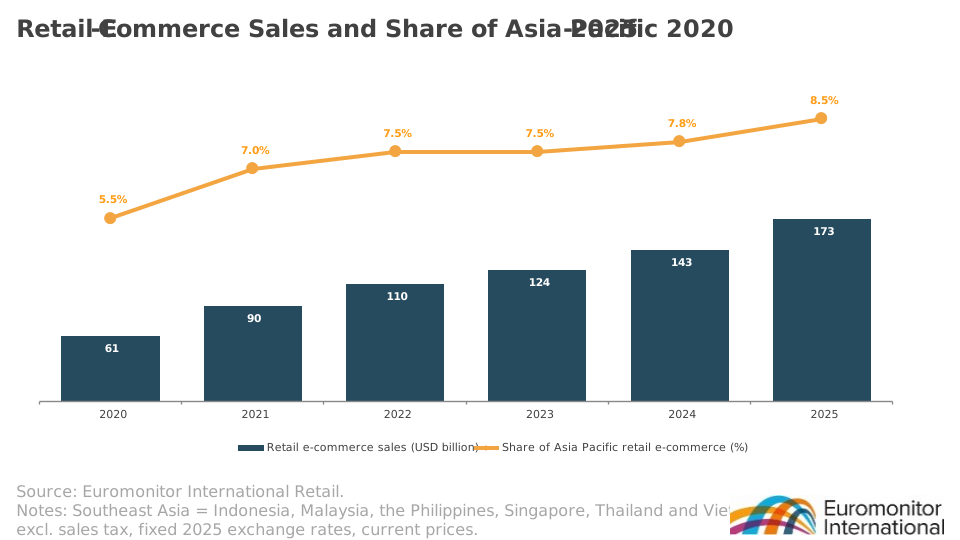
Connected consumers and rising incomes widen the base
The demand side is in place. Across Asia Pacific, the share of the population using the internet rose from 31% in 2015 to an estimated 72% in 2025. It is forecast to reach roughly 80% by 2030. Within Southeast Asia, connectivity is deepening unevenly. Vietnam rose from about 1.3 internet connections per person in 2020 to about 2.1 in 2025. It has overtaken Singapore, which has held at about 2.0. The Philippines, Thailand and Malaysia have also moved up.
Incomes are rising in step. Average incomes among under-40s are about 76% higher in Vietnam than in 2014, and about 35% higher in Indonesia.
Investment in mobile connectivity, digital payments, marketplaces and logistics has lowered the barriers. Brands can reach shoppers more easily, and shoppers can complete purchases with less friction. As a result, online is no longer the home of occasional purchases. Routine categories such as beauty and personal care now carry real weight on the leading marketplaces. The question for brands is increasingly where, rather than whether, shoppers choose to buy online.
Online penetration has further to run
The online share of retail shows how much headroom remains. Euromonitor forecasts that e-commerce will account for 30% of global retail value sales by 2030. Indonesia is forecast to pass that benchmark comfortably, at around 45%. Thailand, the second-largest market, is expected to reach 36%.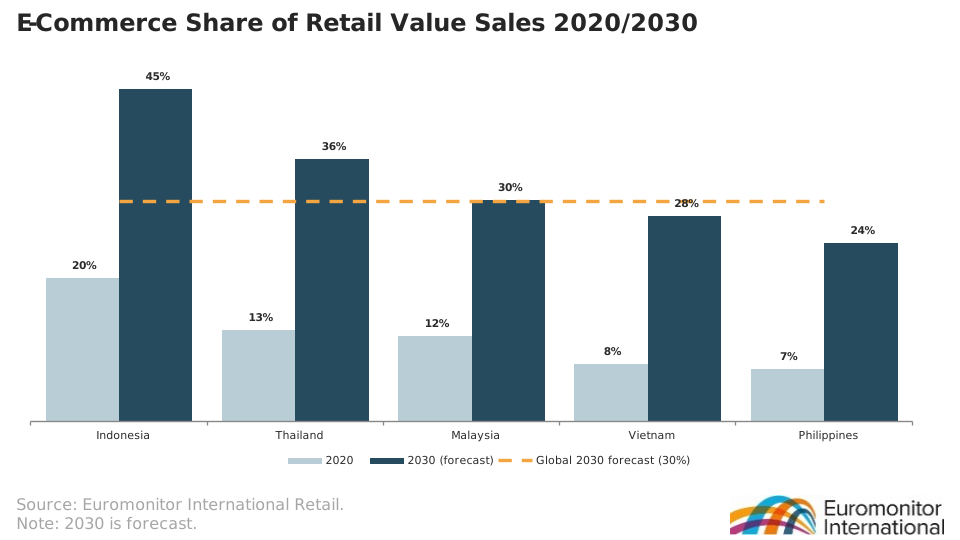
Five growth markets fall into three distinct stories
Behind the regional total, the markets sit at very different stages. Indonesia is the anchor, with around 37% of regional retail e-commerce sales in 2026. Vietnam and the Philippines are the fast risers. They are forecast to grow 19% and 16%, respectively, in 2026, ahead of Indonesia at 14%. Thailand and Malaysia are the steadier pair, forecast to grow around 8%. Thailand remains the second-largest market, at about 21% of sales.
Singapore is the exception. As a mature market with 3% of regional sales, its relevance to brands lies in its role as a regional hub and test bed rather than as a volume opportunity.
Favourable regional trade pacts give brands a route to serve several markets from a shared base. That only works if product, price and platform strategy are adapted market by market.
A single Southeast Asia plan is therefore not enough. The opportunity is large, but the markets differ in scale, speed and maturity, and so does the competition. Shopee, TikTok Shop and Lazada operate across the region, yet their relative strength changes from one market to the next.
We look at what that means for FMCG brands in our companion article, In Southeast Asia, the Winning E-Commerce Decisions Are Local.
Explore Southeast Asia in Passport E-Commerce, which now tracks Shopee, TikTok Shop and Lazada across Indonesia, Malaysia, the Philippines, Thailand and Vietnam, plus Tokopedia in Indonesia.