
Geopolitical tensions, stagnation in major economies, debt distress and climate change are the key risk factors that could result in further disruptions in the global economy. Macroeconomic shocks can have a major impact on business outcomes as they affect production costs, consumer spending power and market potential. As economic uncertainty persists, companies need to judge their business stability against future shocks and be ready for a range of macroeconomic scenarios.
Uncertainty widens the range of plausible outcomes for the global economy
While the baseline is the most likely of several possible scenarios, baseline forecasts are usually surrounded by uncertainty. With market volatility and geopolitical tensions having dominated the global business environment following the COVID-19 pandemic and the war in Ukraine, the range of outcomes for the global economy has widened, tightening the probability of baseline forecasts.
In the midst of economic uncertainty, scenario analysis can provide some clarity and help companies gauge the possible impact of economic shocks on their business
Source: Euromonitor International
Euromonitor International constantly evaluates economic risks and simulates potential economic shocks. Our Q3 2023 forecasts highlight seven alternative outcomes for the global economy apart from the baseline.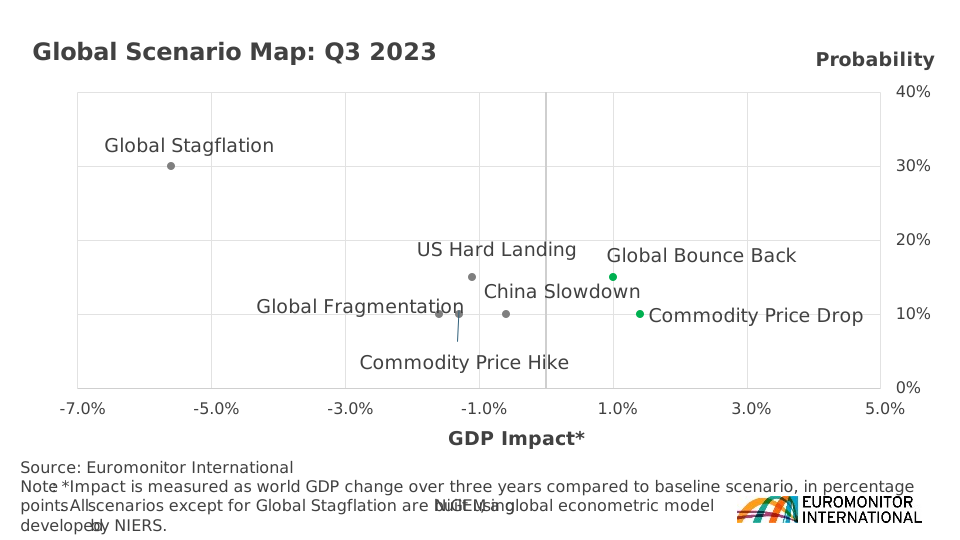
Downside scenarios cloud the outlook
The multiple risks that the global economy is facing keep the likelihood of a downside scenario high. Five risk scenarios could pan out, impacting global growth and inflation: stagflation, global fragmentation, a commodity price hike, a US hard landing and China slowdown.
Global stagflation continues to be the key downside risk, as global prices could resurge due to further disruption to energy and food supply, while the largest economies may face a hard landing amid prolonged restrictive monetary policies and increasing financial instability. Consequently, under this Global Stagflation scenario, global real GDP growth slows to 0.6% in 2023 and 0.2% in 2024. In addition to weaker growth, global inflation rises to 7.7% in 2023 and 6.5% in 2024.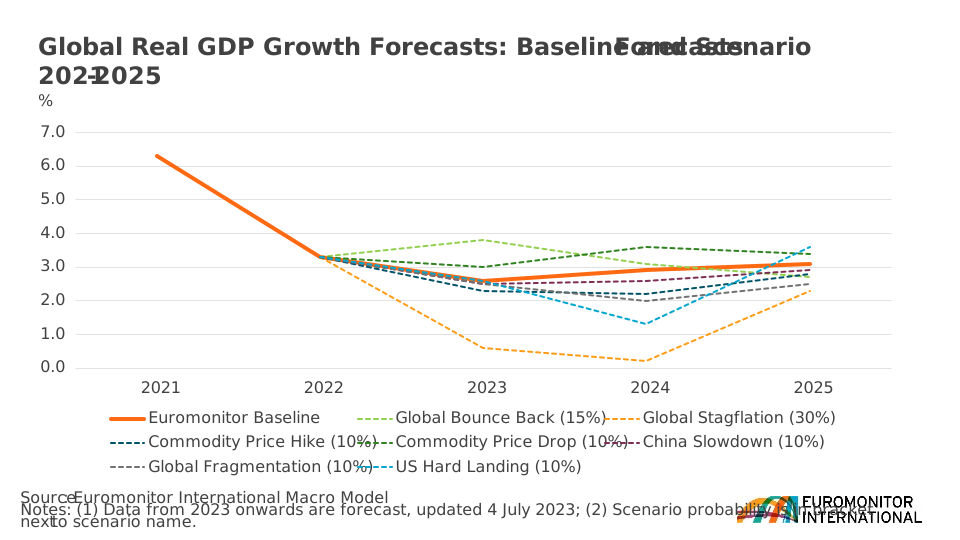
The second risk scenario for the global economy is a deepening fragmentation in the global economy. This scenario assumes that intensified geopolitical tensions lead to economies dividing into multiple blocs, with trade wars and protectionism resulting in a permanent rise in trading costs.
Under a Global Fragmentation scenario, trade-dependent economies will be hit the hardest in the near term, while in the medium and long term, most markets, and thus the global economy, will face slower growth potential and greater volatility in prices
Source: Euromonitor International
Further supply disruptions and lower production or export of commodities due to conflict or decisions from key suppliers, such as the Organization of the Petroleum Exporting Countries (OPEC) could lead to a permanent rise in global commodity prices. Under this Commodity Price Hike scenario, high commodity prices will lead to higher inflation and hit demand, and the global economy would see slower growth in both 2023 and 2024, at 2.3% and 2.2% in real terms, respectively.
Finally, both the US (the world’s largest economy) and China (the world’s second largest economy) can face the risk of a deeper downturn. In the US, a weakening of consumption and investment due to higher-for-longer interest rates could lead to a hard landing of the economy. China could see a greater slowdown, if both the short-term growth outlook and long-term growth potential worsen due to a deeper real estate sector crisis, faster population decline and technological progress slump. A US hard landing or China slowdown could shave off global growth by 0.3-1.5 percentage points each year in the next two years.
Upside scenarios possible with risks abating
Several factors could lead to a better-than-expected performance of the global economy, including a de-escalation of the war in Ukraine, an increase in public spending in key economies and lower commodity prices.
In Euromonitor International’s Global Bounce Back scenario, better-than-expected geopolitical developments and stronger performance of key economies, including the US and China, could result in global real GDP growth of 3.8% in 2023
Source: Euromonitor International
This growth represents an increase of 1.2 percentage points relative to the baseline. Meanwhile, inflation remains largely unchanged in 2023 and 2024 as various inflation impulses offset each other.
The Commodity Price Drop scenario assumes that more renewable resources, higher output or production efficiency gains lead to a permanent decline in global commodity prices. This will benefit the global economy as a whole, as it can reduce production costs for businesses, ease the cost of living for consumers and improve the terms of trade for commodity-importing countries. In this scenario, the global economy could grow by 3.0% in 2023 and 3.6% in 2024, 0.4 and 0.6 percentage points higher than the baseline.
While baseline forecasts can be wrong, using macro scenarios can help minimise surprises by examining the impacts of downside risks and upside opportunities. Incorporation of alternative macroeconomic scenarios as part of market research leads to more robust strategy planning, and a better response to negative shocks.
Read our extract, Global Economic Forecasts: Q3 2023, for more analysis on global economic risks and how to prepare for economic shifts.